



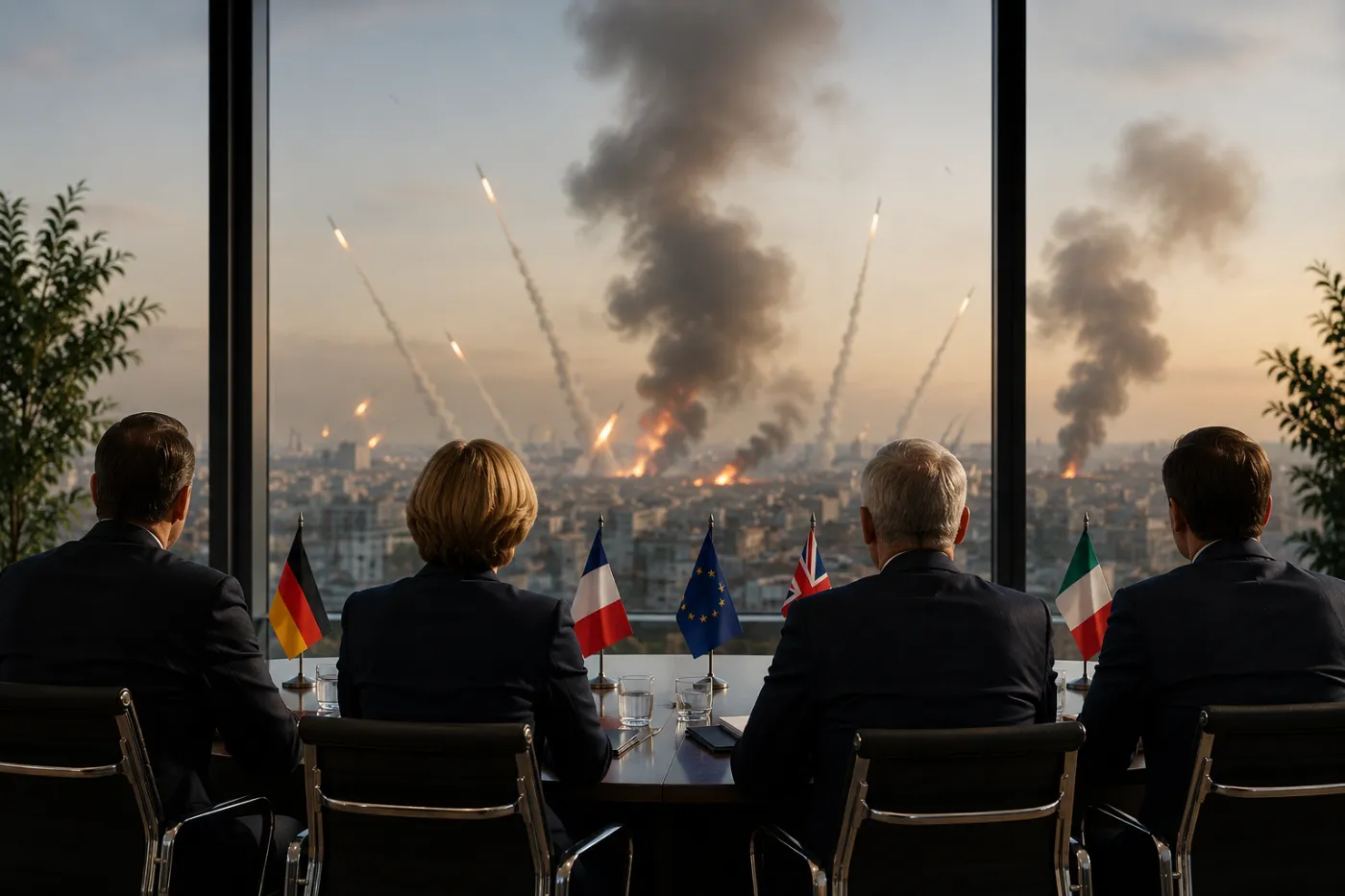

Europe has mastered the language of power. It speaks of strategic autonomy, rules-based order, deterrence, burden-sharing and global responsibility. But in the Middle East, when the language of diplomacy gives way to the grammar of force, Europe’s voice often becomes faint.
The latest crisis has exposed this familiar silence once again. European capitals are alarmed by the prospect of regional war. They fear disruption in the Strait of Hormuz, the destabilization of global energy markets, renewed migration pressures, the expansion of Iranian proxy warfare and the erosion of what remains of diplomatic leverage over Tehran. Yet despite these interests, Europe remains largely unable to act as an independent military force.
It can warn. It can condemn. It can mediate. It can sanction. It can coordinate. But it cannot, on its own, impose order.
President Emmanuel Macron’s recent comments on the Strait of Hormuz were revealing precisely because they came from France, the European state most comfortable with the language of strategic power. Macron said France had “never considered” a unilateral military deployment in the strait and emphasized that any effort to restore maritime traffic should be coordinated with Iran. In other words, even Europe’s most assertive military actor was careful not to present itself as an independent enforcer in one of the world’s most sensitive chokepoints.
That caution was not a diplomatic accident. It was a confession of Europe’s strategic reality.
For decades, Europe has lived inside a contradiction. It has vast interests beyond its borders, but limited capacity to defend them without the United States. Nowhere is that contradiction clearer than in the Middle East. The region affects Europe’s energy security, commercial shipping, counterterrorism posture, migration politics and domestic stability. Yet when the region enters a phase of open military confrontation, Europe usually becomes a supporting actor.
This is not because Europe is indifferent. It is because Europe is dependent.
The United States remains the only Western power with the military infrastructure to operate decisively across the Middle East: aircraft carriers, air bases, refueling capacity, intelligence networks, missile defense systems, logistics chains and command structures. European states can contribute to coalitions. They can send ships, aircraft and special forces. But contribution is not command. Participation is not strategic autonomy.
This distinction matters.
Europe’s dilemma is often described as a failure of will. That is too simple. It is also a failure of design. The European Union was built as a peace project, a regulatory power and an economic bloc, not as a military actor capable of rapid coercion in contested regions. Its decision-making is slow. Its threat perceptions are fragmented. Its military capabilities are uneven. Its publics are deeply skeptical of another Middle Eastern war.
France thinks differently from Germany. Germany thinks differently from Poland. Southern Europe worries about migration and the Mediterranean. Eastern Europe worries first about Russia. Britain remains militarily relevant but is outside the EU. The result is not one European strategy, but several overlapping anxieties.
This fragmentation produces a familiar pattern: Europe aligns with Washington, but tries not to own Washington’s wars.
That posture is understandable. The Iraq war damaged European trust in American judgment. Afghanistan showed the limits of Western state-building. Libya demonstrated that intervention without a durable political plan can create long-term instability. European leaders learned that military action is easy to begin and difficult to conclude.
But the lesson Europe drew was incomplete. It learned to distrust intervention without building the capacity for credible alternatives.
That is why “strategic autonomy” has become one of the most overused and underdeveloped phrases in European policy. The concept promises a Europe able to act independently when its interests require it. But in practice, Europe still relies on NATO, and NATO still relies heavily on the United States.
The EU’s proposed Rapid Deployment Capacity of up to 5,000 troops is useful as a symbol of ambition. But it does not amount to a serious instrument for power projection in the Gulf. A force of that size may help with evacuations, limited stabilization missions or crisis management. It cannot secure the Strait of Hormuz under missile, drone, mine and proxy threat.
The Strait of Hormuz is not a theoretical test case. It is one of the world’s most dangerous strategic passages. A military operation there could trigger confrontation with Iran, expose commercial shipping to retaliation, and draw outside powers into an escalation spiral. Any force operating there would need air defense, mine-clearing capability, intelligence, surveillance, maritime escorts, logistics and political stamina.
Europe has some of these tools. It does not have enough of them collectively, quickly or independently.
Macron knows this. His caution over Hormuz was not simply about avoiding provocation. It reflected an understanding that France, and certainly Europe, cannot easily replace the United States as the guarantor of Gulf security. France can signal. It can deploy. It can coordinate. But it cannot alone reshape the regional balance.
This is why Europe’s posture appears so passive. It is not passive because nothing is at stake. It is passive because almost everything is at stake, and Europe lacks the instruments to control the consequences.
There is also a deeper political problem. European publics have little appetite for another Middle Eastern military entanglement. Leaders in Paris, Berlin, Rome and Madrid know that any operation framed as a step toward war with Iran would face domestic scrutiny. The memory of Iraq remains politically toxic. The failure of Afghanistan remains fresh. Libya remains an unresolved warning.
So Europe chooses the safer vocabulary: de-escalation, coordination, diplomacy, restraint.
These are not empty words. They are necessary. A rush to military confrontation in the Gulf could be disastrous. But when diplomacy is not backed by credible power, it becomes less a strategy than a preference.
This is Europe’s Middle East problem in one sentence: It is deeply exposed to the region’s instability but only partially equipped to shape the region’s security.
The irony is that Europe often suffers the consequences of crises it cannot control. A war in the Gulf can raise energy prices in Europe. Instability in Syria, Iraq or Lebanon can fuel migration pressures. Terrorist networks and proxy conflicts can affect European domestic security. Maritime disruption can hit European trade. Yet the hard-power response is still largely American.
Europe is therefore neither absent nor decisive. It is present as a diplomatic actor, a humanitarian donor, a sanctions power and a moral voice. But in a hard-power crisis, those tools are not enough.
This does not mean Europe should imitate the United States. Nor does it mean that military intervention is the answer to every Middle Eastern crisis. Europe’s caution is often wiser than Washington’s impulse toward coercion. But caution without capability is not strategy. It is dependency with better language.
If Europe wants to be taken seriously as a strategic actor, it must answer questions it has long avoided. What interests in the Middle East is it actually prepared to defend? What risks is it willing to take to protect maritime security? What military capabilities is it willing to fund? What decision-making reforms is it willing to accept? And what does strategic autonomy mean if, in every major crisis, Europe still waits to see what Washington will do?
Until those questions are answered, the phrase “European power” will remain more aspiration than reality.
Macron’s comments on Hormuz should therefore be read not as an isolated French position, but as a diagnosis of Europe’s condition. Even the most assertive European power chose caution over coercion, coordination over command, and diplomatic hedging over unilateral military action.
That may have been the right choice. But it was also a revealing one.
Europe is not silent because it has nothing to say. It is silent because it has not built the means to make its words decisive.
And so, in the Middle East, all remains quiet on the Western front. Not the quiet of peace, but the quiet of a continent still dependent on another power to defend the order it claims to uphold.