




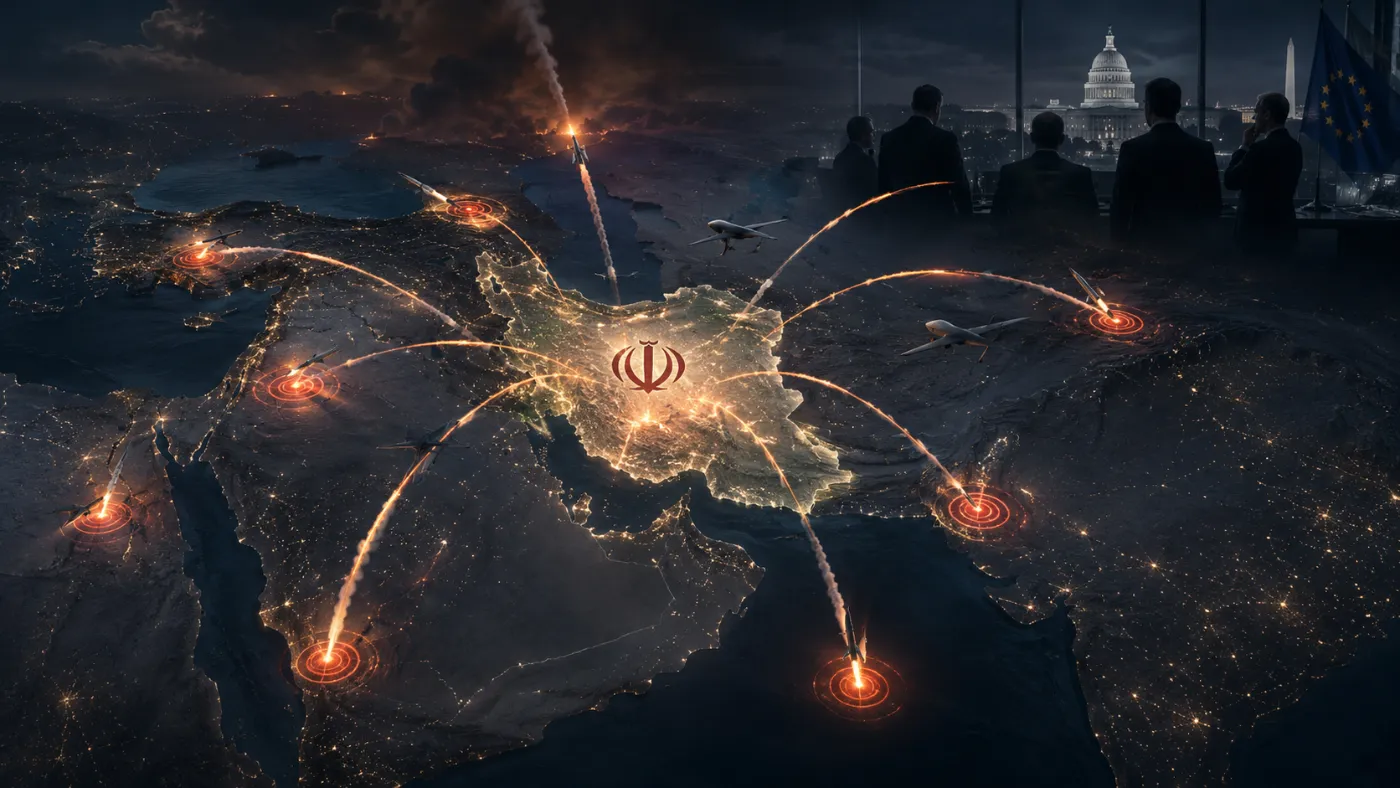

In late February 2026, following a clandestine U.S. Israeli strike on Iran (Operation “Epic Fury,” which killed Iran’s Supreme Leader), Tehran unleashed a multi-front retaliation. Within hours, waves of ballistic missiles, cruise missiles and kamikaze drones struck American and allied targets across the Middle East. By March 2026, Iran’s actions had affected at least eight countries including Bahrain, Kuwait, Qatar, Saudi Arabia, the UAE, Iraq, Jordan and Oman damaging military bases, oil infrastructure and civilian areas. Simultaneously, Iran’s allies (Hezbollah in Lebanon, Houthi rebels in Yemen, Iraqi militias) opened new fronts, and Iranian cyber units threatened Western critical networks. These strikes demonstrated Iran’s resilience: its vast missile/drone arsenal, proxy networks and external partnerships (notably with China) kept Iran’s regime intact despite heavy losses. In contrast, the U.S. and European powers, bound by legal norms and strategic constraints, limited their response. Western governments condemned the attacks and bolstered regional defenses, but stopped short of a full-scale invasion or regime overthrow. Factors included UN legal limits, alliance cohesion (EU/NATO divisions), fear of wider war (Russia/China involvement or Middle East instability), and concerns over global oil markets. Experts caution that while stronger action (e.g. occupation of Iran) might degrade Tehran, it risks regional chaos. Instead, policymakers have thus far opted for defensive measures, sanctions and diplomacy. This article provides a detailed timeline of Iranian actions post-strike, a country-by-country impact analysis, an examination of Iran’s asymmetric capabilities, and an assessment of why the West held back – all supported by primary sources and expert commentary.
Timeline of Iranian Actions
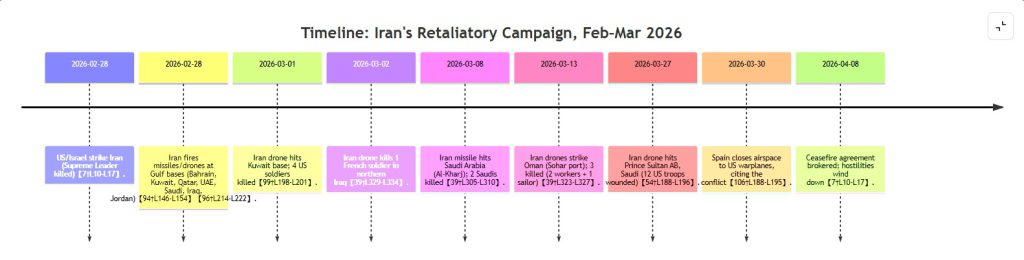
On 28 Feb 2026, hours after news of Iran’s strike on U.S./Israeli forces, Iran’s Islamic Revolutionary Guard Corps (IRGC) declared it was exercising “decisive self-defence”. That afternoon Iran launched barrages of missiles and drones at U.S. bases and allied sites across the Gulf. In Kuwait, several missiles targeted Ali al-Salem Air Base (U.S. Patriot site) and a Shahed drone hit Kuwait City’s airport, injuring some civilian workers. Bahrain reported missiles and drones struck near the U.S. Fifth Fleet HQ in Manama. Qatar’s defence ministry said its radars intercepted “all missiles” aimed at its territory. Saudi Arabia’s forces shot down incoming rockets aimed at Riyadh. The United Arab Emirates (UAE) took missile fire on Abu Dhabi: state media confirmed one Emirati killed after an Iranian missile was intercepted above the capital. In Iraq, Iranian drones attacked Erbil’s international airport (all shot down) and bombed a Kata’ib Hezbollah militia HQ south of Baghdad (killing two militia fighters). Even Syria saw collateral damage: a stray missile landed in Sweida province, killing four civilians. Jordan, though not hit directly, reported dozens of Iranian missiles and drones crossing its airspace; all were intercepted by Jordanian and U.S. systems.
In the days following the initial barrage, Iran kept up pressure. On 1 Mar 2026, Iran’s media boasted of further strikes, and a Shahed drone slammed into a U.S. troop housing complex in Kuwait, killing four American soldiers (the first U.S. combat deaths). (By March 3, the U.S. Pentagon confirmed “they died on Sunday when a drone slammed into a U.S. military facility in Port Shuaiba, Kuwait”.) On 2 Mar, an Iranian drone struck an Iraqi base where U.S. and allied troops were training, killing one French soldier and wounding several. 8 Mar saw another Iranian missile hit Saudi Arabia – a Shahab-3 projectile fell in al-Kharj, southeast of Riyadh, killing two local civilians. 13 Mar, Iranian drones bombed the Sohar port in Oman (2 foreign workers dead) and another hit an oil tanker off Oman’s coast (1 dead). Over late March, missile intercept debris and additional drone strikes caused further casualties: one person died in Abu Dhabi from falling shrapnel, and Iranian projectiles damaged pipelines and tanks in the UAE’s Habshan oil field. One striking incident on 27 Mar was an Iranian drone attack at Prince Sultan Air Base in Saudi Arabia (coordinated with U.S. forces), wounding 12 American soldiers. Finally, as talks and ceasefire discussions began, Iran’s combined launch tally reached over 500 missiles and 2,000 UAVs, according to U.S. Central Command. By early April, diplomacy took hold: a tentative ceasefire on 8 April was brokered, but only after six weeks of sustained conflict.
On 28 Feb 2026, hours after news of Iran’s strike on U.S./Israeli forces, Iran’s Islamic Revolutionary Guard Corps (IRGC) declared it was exercising “decisive self-defence”. That afternoon Iran launched barrages of missiles and drones at U.S. bases and allied sites across the Gulf. In Kuwait, several missiles targeted Ali al-Salem Air Base (U.S. Patriot site) and a Shahed drone hit Kuwait City’s airport, injuring some civilian workers. Bahrain reported missiles and drones struck near the U.S. Fifth Fleet HQ in Manama. Qatar’s defence ministry said its radars intercepted “all missiles” aimed at its territory. Saudi Arabia’s forces shot down incoming rockets aimed at Riyadh. The United Arab Emirates (UAE) took missile fire on Abu Dhabi: state media confirmed one Emirati killed after an Iranian missile was intercepted above the capital. In Iraq, Iranian drones attacked Erbil’s international airport (all shot down) and bombed a Kata’ib Hezbollah militia HQ south of Baghdad (killing two militia fighters). Even Syria saw collateral damage: a stray missile landed in Sweida province, killing four civilians. Jordan, though not hit directly, reported dozens of Iranian missiles and drones crossing its airspace; all were intercepted by Jordanian and U.S. systems.
In the days following the initial barrage, Iran kept up pressure. On 1 Mar 2026, Iran’s media boasted of further strikes, and a Shahed drone slammed into a U.S. troop housing complex in Kuwait, killing four American soldiers (the first U.S. combat deaths). (By March 3, the U.S. Pentagon confirmed “they died on Sunday when a drone slammed into a U.S. military facility in Port Shuaiba, Kuwait”.) On 2 Mar, an Iranian drone struck an Iraqi base where U.S. and allied troops were training, killing one French soldier and wounding several. 8 Mar saw another Iranian missile hit Saudi Arabia – a Shahab-3 projectile fell in al-Kharj, southeast of Riyadh, killing two local civilians. 13 Mar, Iranian drones bombed the Sohar port in Oman (2 foreign workers dead) and another hit an oil tanker off Oman’s coast (1 dead). Over late March, missile intercept debris and additional drone strikes caused further casualties: one person died in Abu Dhabi from falling shrapnel, and Iranian projectiles damaged pipelines and tanks in the UAE’s Habshan oil field. One striking incident on 27 Mar was an Iranian drone attack at Prince Sultan Air Base in Saudi Arabia (coordinated with U.S. forces), wounding 12 American soldiers. Finally, as talks and ceasefire discussions began, Iran’s combined launch tally reached over 500 missiles and 2,000 UAVs, according to U.S. Central Command. By early April, diplomacy took hold: a tentative ceasefire on 8 April was brokered, but only after six weeks of sustained conflict.
Affected Countries: Actions and Impacts
Iran’s campaign struck eight countries around the Gulf. The table below summarizes the dates, methods, perpetrators and effects in each:
| Country | Date(s) | Action | Actors | Effects |
|---|---|---|---|---|
| Bahrain | 28 Feb 2026 | Missiles, UAVs at Manama | IRGC (Shahed UAVs) | U.S. 5th Fleet HQ area hit; several civilian buildings struck. (No military casualties reported.) |
| Kuwait | 28 Feb, 1 Mar 2026 | Ballistic missiles; drones | IRGC | Ali al-Salem AB (Patriot site) targeted (all missiles intercepted); Kuwait Intl Airport hit by drone (minor damage, some staff injured); 4 US soldiers killed at Shuaiba base (Mar1). |
| Qatar | 28 Feb 2026 | Intercepted missiles | IRGC | Doha’s air defenses downed all incoming rockets. Gulf LNG exports briefly disrupted (QatarEnergy reported ~17% output drop). |
| UAE | 28 Feb & Mar 2026 | Cruise missiles, drones | IRGC | Abu Dhabi hit by missile (1 Emirati killed on Feb28); Dubai saw fires from drone debris; storage tanks, pipelines at Habshan Damaged (shrapnel effects). |
| Saudi Arabia | 28 Feb, 8 Mar, 9 Apr 2026 | Missiles, UAVs | IRGC | Feb28 rockets toward Riyadh (all intercepted); 8 Mar – missile hits Al-Kharj (2 killed, 12 injured); 9 Apr – site in Shaybah oil field struck (1 Saudi killed). US/Saudi Patriot batteries engaged most threats. |
| Iraq | 28 Feb – Mar 2026 | Drones, missiles | IRGC, Iraqi militias | Erbil airport attacked (intercepted by Kurdish forces); southern Baghdad: drone killed 2 Kata’ib Hezbollah fighters; Jurf al-Nasr base struck (PMF casualties). Iraq’s UN envoy condemned Iran’s actions. |
| Jordan | 28 Feb – Mar 2026 | Missile and drone overflights | IRGC | Dozens of Iranian UAVs/missiles crossed Jordanian airspace (intercepted by Royal Jordanian Air Force). No direct hits or casualties, but air defense operations were on high alert. |
| Oman | 28 Feb – Mar 2026 | (None by IRGC) | – | Remarkably, Iran did not target Oman. Oman had been hosting Iran–US diplomatic talks (now collapsed). |
Table: Iranian strikes and proxy attacks by country (Feb–Mar 2026).
Israel and Lebanon were also affected indirectly. Israel intercepted hundreds of rockets launched by Hezbollah from Lebanon and Iran on 28 Feb, causing several civilian casualties. Hezbollah’s role shows how Iran’s proxy network opened a northern front. Iran’s influence in Yemen similarly spurred Houthi missile barrages on Saudi targets and Red Sea shipping. (These allied actors complicated any single counterstrike on Iran itself.)
Iran’s Capabilities and Strategy
Iran’s ability to strike so widely stems from multiple strengths:
- Massive missile/drone inventory: Iran had spent years building underground factories to churn out low-cost drones (e.g. Shahed UAVs) and ballistic missiles. CENTCOM reported Tehran launched “over 500 ballistic missiles and over 2,000 drones” in this campaign. These huge stocks enabled saturation attacks that overwhelmed defenses. Analysts note that Iran’s strategy of “drone swarming” (launching inexpensive kamikaze UAVs by the hundreds) depletes opponents’ missiles and keeps campaigns going. Iran’s medium-range ballistic missiles (Shahab, Qiam) gave it reach across the region, meaning targets from Israel’s Haifa to Bahrain’s naval base were within range. Even so, many incoming missiles were intercepted, which underscores how close some strikes came to success in civilian areas.
- Proxy and militia networks: Iran commands a web of allied forces across the Middle East. In Iraq, Iran-backed militias (Kata’ib Hezbollah, Asaib Ahl al-Haq, etc.) attacked U.S. installations in tandem with IRGC orders. Lebanon’s Hezbollah fired hundreds of rockets into northern Israel, tying down Israeli defenses. In Yemen, the Iran-aligned Houthi rebels threatened Saudi and Emirati targets (and global shipping). These groups act as force multipliers – Western strikes on Iran risk provoking them, and they create multiple battlefronts. For example, after the strike on Iran, Israel began bombing Lebanese Hezbollah positions. Such “multi-front” pressure is part of Iran’s asymmetric doctrine.
- Economic and diplomatic lifelines: Despite sanctions, Iran’s economy and regime survived. Crucially, China remained a major customer for Iranian oil (often underpriced or smuggled), shoring up Iran’s revenue. China and Russia also shielded Iran diplomatically: at the UN, both abstained rather than vetoing a resolution condemning only Iran’s strikes. This diplomatic cover prevented Tehran from being completely isolated. Domestically, Iran’s government maintained cohesion; Supreme Leader Khamenei’s succession was quickly managed, avoiding a power vacuum. State propaganda rallied Iranians around the theme of resisting aggression. All this meant Iran could keep fighting: as an IRGC commander boasted, the campaign would continue “until the enemy [is] decisively defeated.”
- Cyber and electronic warfare: Iran’s cyber units prepared to attack U.S. targets as soon as the conflict began. Even under a nationwide internet blackout at home, Iran re-routed communications via satellite links like Starlink. U.S. agencies warned of Iranian-backed hackers probing Western critical infrastructure (power grids, water utilities and transportation) in early March. These capabilities – including electronic jamming and anti-satellite operations – amplify Iran’s reach beyond kinetic strikes.
- Asymmetric doctrine: Iran’s experience from the Iran–Iraq war gave it an attrition mindset. Even when its cities were bombed (e.g. hundreds of cruise missiles reportedly hit Iranian provinces in retaliation), the regime tolerated civilian suffering to keep fighting. Iran’s leadership openly spoke of martyrdom and avoidance of direct confrontation. This mindset, plus the regime’s suppression of internal dissent, meant Tehran suffered few political consequences. It allowed IRGC generals and militia leaders to promise vengeance without fearing a popular pushback.
These factors combined meant Iran was able not only to hit multiple neighbours simultaneously, but to absorb substantial hits without falling apart. By early March, General H.R. McMaster (former U.S. NSC advisor) was warning that Iran “is not close to being finished” – its ability to keep launching attacks remained significant.
Western Policy Responses and Constraints
The U.S. and its European partners faced a dilemma: they wanted to punish Iran, but feared full war. A range of legal, political and strategic factors shaped a limited response:
- Alliance and political divides: The 2026 attacks found NATO and EU members split. The U.S. and Israel led the initial strike on Iran, but most European capitals did not join directly. British PM Keir Starmer stressed that “the UK did not participate” in the U.S.–Israel strike. He did approve defensive deployments (e.g. sending missile batteries to the Gulf), but refused to commit British jets for attacks on Iran. Germany’s Chancellor Friedrich Merz (a Trump ally) echoed reluctance: he publicly reminded allies that Germany “would not lecture” the U.S. while seeking assurances not to drag Europe into the fight. In contrast, Poland, the Baltics and Czechia urged a hard line on Iran, but their influence was limited.This division extended to bases. Spain and Italy denied U.S. refuelling and overflight for strike missions. On 30 March Spain officially closed its airspace to U.S. warplanes participating in the Iran war, with Defence Minister Robles saying Spain “don’t authorize either the use of military bases or the use of airspace for actions related to the war in Iran.” Prime Minister Pedro Sánchez had described the strikes as “reckless and illegal”. Italy similarly refused U.S. requests to use Sigonella airbase (though it later partly relented). The only major European support came in the form of shared surveillance, intelligence and arms shipments (e.g. additional Patriots sent to protect Gulf airspace). But by early April Europe was clearly “scrambling” as a secondary actor: it condemned Iran’s strikes at the UN but left the fighting to the U.S./Israel core.
- International law and UN politics: Western democracies were wary of openly flouting the UN Charter. The U.S. strike on Iran (Feb 28) had proceeded without Security Council authorization, justified only as self-defense. Putin and Xi condemned that unilateral U.S. action at the UN, casting doubt on Western legal grounds. When Gulf Arab states pushed a draft UN resolution against only Iran’s strikes, China and Russia abstained rather than vetoing – which let it pass on 11 March. This resolution “in the strongest terms” condemned Iran’s attacks on Bahrain, Kuwait, Oman, Qatar, Saudi Arabia, the UAE and Jordan, but notably ignored mention of the U.S./Israeli strikes. Russia’s UN envoy complained this made the Council look “unbalanced”. The lack of a reciprocal resolution limiting U.S. action left the U.S./Israel on shaky legal ground. Consequently, the U.S. treaded carefully: it expanded sanctions and conducted selective strikes (for example, hitting some IRGC missile sites in Iran’s northwest) but avoided direct attacks on Iran’s political leadership or nuclear facilities, which would have no clear international mandate.
- Energy and economic interests: Europe’s vulnerability to Middle East disruption was a critical constraint. The Strait of Hormuz blockade (imposed when Iran threatened to close it) sent oil prices soaring above $100/barrel. European economies – still shaky from COVID and Ukraine crises – were hit hard. The CFR’s Liana Fix emphasizes that “soaring gas prices” from Hormuz closures renewed inflation fears in Europe. For example, the UK convened 40 nations in March to secure Hormuz shipping lanes (protecting oil tankers) instead of joining strikes in Iran. Ironically, European reluctance mirrored their 2022 caution on Ukraine: unwilling to pick fights that could backfire on their own energy security. In Washington, officials worried similarly: a protracted Gulf war might draw resources (munitions, ships) away from NATO’s eastern flank. Secretary of Defense visits hinted the US prioritized Ukraine support even while accelerating strikes in the Middle East.
- Domestic politics and wariness: Neither U.S. president (Biden or Trump) could easily sell a broader war to their electorates. Public opinion in 2026 was fatigued by decades of Middle East wars. Congress members were ambivalent, demanding that the Iran fight not overshadow Ukraine or domestic issues. National security establishment (NSA, Pentagon, intel) advocated restraint; law-makers insisted any action remain defensive. Even President Trump, who ordered parts of the Feb 28 strike, privately urged allies to handle their own security: he famously tweeted, “If Spain or Italy want to remain neutral, let them… We have more important things to do with NATO.” (He also publicly threatened economic retaliation against Spain for withholding bases.) The cumulative effect was a preference for the status quo: degrade Iran’s strike capability via drones, cyber, sanctions – but stop short of invasion or regime change.
- Resource and strategic limits: The U.S. military had finite resources. Thousands of troops, ships and missiles were already committed to Ukraine and Indo-Pacific. President Biden needed to calibrate – enough strike power to deter Iran, but not so much to ignite all-out war. Adm. Mike Franko (CENTCOM commander) noted that U.S. warships could only enforce an interdiction around Iran for limited time. More importantly, any full invasion risked drawing Iran’s deep reserves and allies (Russia, China) further into conflict. Top American generals privately warned that wiping out Iran’s capabilities might “engulf the region” in a new multi-decade war. In short, Western strategy has been to compete but not conquer.
In sum, the U.S. and Europe chose defensive deterrence over regime decapitation. They publicly demanded Iran stop its attacks (via UN and media) and quietly bolstered regional air defences (sending more Patriot, THAAD and Aegis units). They also intensified sanctions on Iran’s economy (targeting its central bank and petrochemicals) and pressured China/Russia diplomatically to stop enabling Tehran. But they avoided any strike on Iranian nuclear or political targets, or an outright blockade – actions that would break international law and provoke the very wider conflict they feared.
Alternative Approaches and Consequences
Security analysts have debated what more forceful or different policies could have been pursued, and their risks:
- Enhanced diplomacy and sanctions: One option would be to double down on international pressure, using the UN and alliances. For example, Europe could push the U.S. to re-engage in talks (building on the 2023 Vienna diplomacy) in exchange for deeper sanctions relief and Iranian strictures. The UK-led naval mission securing Hormuz, and Gulf states’ diplomatic outreach (e.g. Bahrain, Oman urging calm), are part of this approach. Experts like Liana Fix argue that Europe has leverage (bases, tech) to demand clear security guarantees in return for support. The likely outcome: a tenuous stalemate. Global markets might recover as Hormuz threats subside, and Iran would face harsher economic isolation. But Tehran might view this as West letting it off lightly, and could resume its asymmetric attacks later or push harder on its nuclear program. The regime’s internal propaganda would celebrate survived Western pressure, potentially hardening its belligerence.
- Bolstered regional defence: A middle path is to massively increase Gulf defenses and allied forces. This means permanently stationing thousands more U.S. troops in the Gulf (beyond the small Marine garrison), deploying additional carrier strike groups, THAAD batteries in every emirate, and improving missile protection for all shipping. Some analysts recommend integrating Gulf states into air defence networks (U.S./NATO-style) and investing in Kuwaiti/Qatari naval forces to counter Iran’s Revolutionary Guard Navy and mines. Consequence: This would make Gulf states safer from massed missile swarm attacks. However, it risks cementing a prolonged U.S. presence (attracting Iranian guerrilla tactics, sabotage, or domestic unrest over foreign troops). It could also alienate Iraq and others who view heavy U.S. presence as occupation. Importantly, it would not end Iran’s offensive capabilities – it only contains them, at great cost.
- Full military escalation: Hardliners suggest striking deep inside Iran: hitting IRGC bases, nuclear sites or even regime leadership (as was briefly considered after Soleimani’s killing in 2020). This could theoretically cripple Iran’s war machine quickly. But the consensus of war studies is that this is almost certain to spark a larger war. Iran would retaliate massively (including on Israel via proxies), and could accelerate any nuclear weapons program as a final resort. The Gulf would see even more destruction, and countries like Iraq or Lebanon could collapse into further conflict. Global oil could spike into unprecedented levels. In effect, this is a path to mutual assured destruction in the region. Both U.S. administrations in 2026 stepped back from this, deeming it too unpredictable.
- Proxy counter-offensive: Another route is to use Iran’s own game against it: strengthen anti-Iran proxies (the Kurds, Houthi opponents, Bahraini opposition) and conduct covert strikes (cyberattacks like ‘Stuxnet 3.0’ against IRGC infrastructure, or clandestine ops against top commanders). For instance, Israel reportedly intensified strikes on Syrian IRGC facilities. The U.S. could arm anti-Houthi Yemeni factions to pressure Iran’s southern flank. Outcome: Iran might be diverted by new crises, but proxies can spiral out of control. We saw in 2025 how empowered Iran-linked militias in Iraq attacked U.S. bases even without IRGC orders, leading to unintended U.S. casualties. Similarly, using proxies can backfire with civilian blowback (as in Yemen).
- Status quo containment: Finally, the West could simply accept Iran’s conventional arsenal as largely unshakable and focus on deterrence and normalization. This means routine diplomatic engagement (along with sanctions), regular intelligence operations, and a tacit acknowledgement of Iranian influence zones. This is essentially keeping the pre-2026 equilibrium with heighted vigilance. It risks conceding to Iran a stronger hand over time (since Iran sees itself as having “won” by surviving the strikes). But it avoids open warfare. Notably, this is close to what many analysts fear: a lingering Cold War with Iran, punctuated by skirmishes but no resolution.
Expert Views: Experts agree there are no easy choices. CFR’s Fix and Bader stress that Europe’s best path is to “use [its] leverage” (bases, drones, diplomacy) to limit damage rather than engage militarily. They note Europe missed opportunities by shunning coordinated action (Spain’s cap, Poland’s proposal for Hormuz patrols) and should perhaps offer UN peacekeeping or demining missions in exchange for Iran halting attacks. Others (IISS analysts) warn any aggressive campaign to destroy Iran’s capacity would unfold into an “endurance battle” with huge civilian costs. In practice, Western policymakers from Washington to Paris decided that deterring Iran’s worst weapons (nuclear, ballistic) was urgent, but that deposing the regime outright was beyond the remit of existing authorizations. As one unnamed NATO official put it to Reuters, “This is not Iraq 2003” – the conditions for regime overthrow simply don’t exist.
In conclusion, Iran’s retaliatory barrage in 2026 showcased its extensive capabilities and networks, hitting at least eight countries and raising the cost of any misstep. Iran remained operational because it had prepared for a war of attrition. The U.S. and Europe have so far settled for containment and deterrence, constrained by law and their own strategic interests. The question now is whether diplomacy and defensive measures will hold the line, or if Iran’s campaign will push the region toward broader conflict. The sources here – from UN documents and Reuters to defense think-tanks – underline the stakes and the thorny trade-offs facing policymakers on both sides.
Sources: Official UN statements, government briefings and statements were used alongside reporting from Reuters, Al Jazeera, and strategic analyses (CFR, IISS, etc.) to compile the timeline and policy assessments. These primary and reputable sources are cited throughout.