




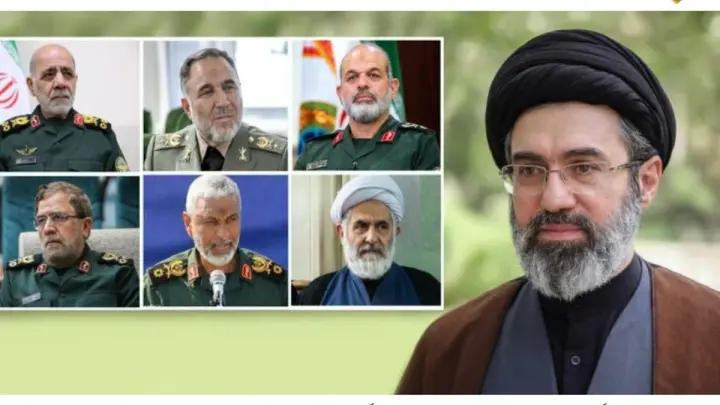

Iran’s leadership has formally appointed six senior military commanders to key positions across the armed forces, the Revolutionary Guards and the Basij, consolidating a wartime command structure while several important intelligence posts remain without publicly announced permanent chiefs.
Iranian state media reported on Monday that Supreme Leader Mojtaba Khamenei issued separate decrees covering six senior positions in the country’s military establishment.
Brigadier General Ali Abdollahi was appointed chief of staff of Iran’s Armed Forces, with former Army Ground Forces commander Kioumars Heydari named his deputy.
Khamenei also promoted Ahmad Vahidi to major general and formally appointed him commander-in-chief of the Islamic Revolutionary Guard Corps. Mostafa Izadi was named deputy commander of the IRGC, while Rear Admiral Ali Azmaei was appointed commander of the IRGC Navy.
Former IRGC intelligence chief Hossein Taeb was meanwhile appointed head of the Basij, the Revolutionary Guards’ paramilitary organization. Taeb previously led the IRGC Intelligence Organization before being removed from that position in 2022 following a series of security breaches and Israeli operations inside Iran.
The appointments formalize several command arrangements that emerged after senior Iranian military officials were killed during the current conflict. Abdollahi replaces Abdolrahim Mousavi, while Vahidi succeeded Mohammad Pakpour and Azmaei emerged as commander of the IRGC Navy following the death of Alireza Tangsiri, according to Iran International.
Despite the reshuffle, significant gaps remain in Iran’s intelligence and security structure.
Neither the IRGC Intelligence Organization nor the Guards’ Intelligence Protection Organization currently has a publicly announced permanent chief following the death of Majid Khademi in an April strike in Tehran, Iran International reported. The police Intelligence Organization also lacks a publicly named permanent successor to Gholamreza Rezaeian.
Other intelligence and operational positions within the Armed Forces General Staff have remained without publicly announced permanent successors since senior officials were killed in Israeli strikes during the June 2025 conflict.
The combination of rapid appointments to operational commands and continuing vacancies in intelligence positions highlights the challenge facing Tehran as it attempts to rebuild a senior security structure repeatedly disrupted by wartime losses and concerns over infiltration.