




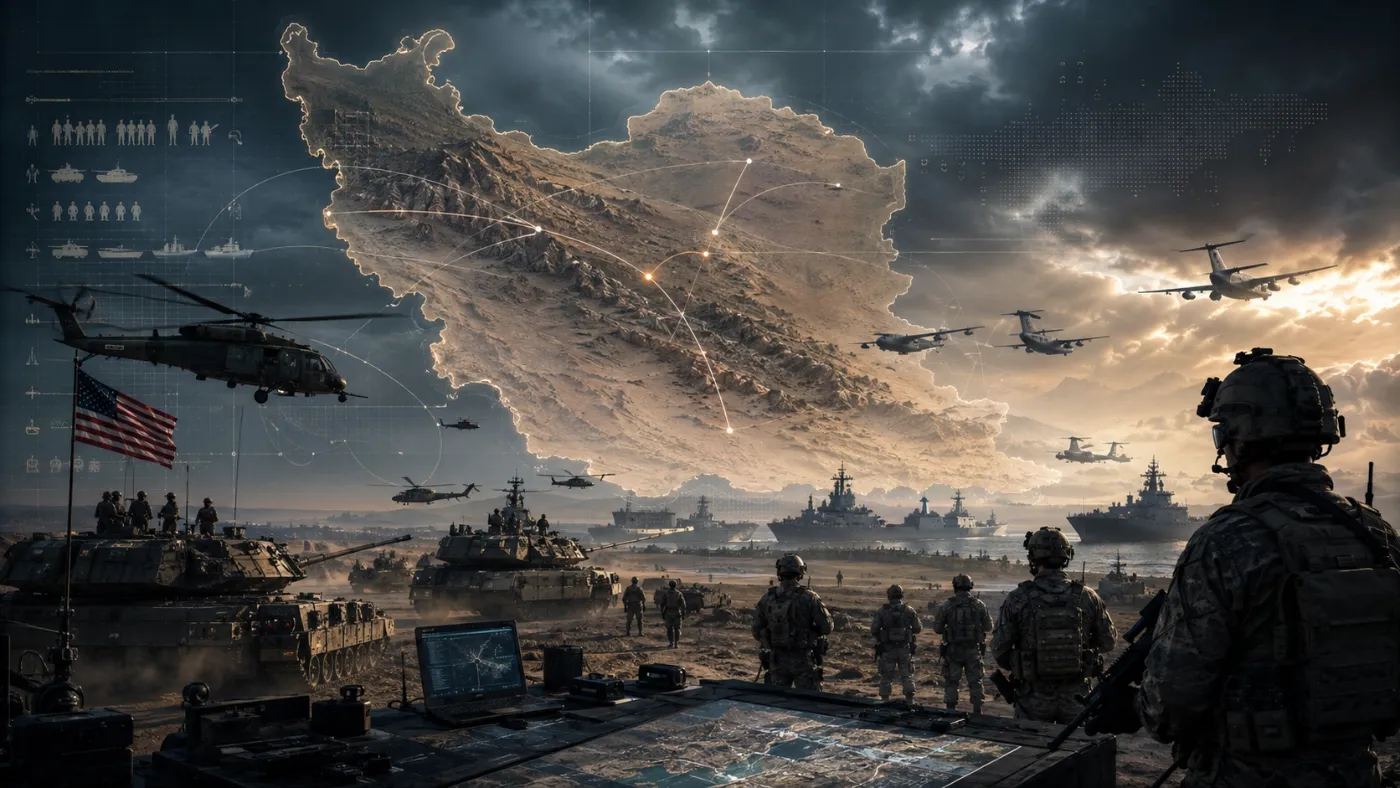

Washington has assembled enough expeditionary power for raids, an island seizure or a limited coastal operation. Publicly available data, however, do not show the divisions, armour and logistical infrastructure required for a full-scale invasion of Iran.
As US attacks increasingly target Iran’s coastal surveillance systems, military logistics, underground weapons storage and maritime capabilities, speculation is growing that Washington may be preparing for a ground operation.
The available evidence presents a more complicated picture.
The United States has significantly expanded its ability to conduct limited operations on Iranian territory. It now has two Marine expeditionary units in the region and deployed elements of the Army’s 82nd Airborne Division earlier in the conflict.
However, the publicly identifiable expeditionary force remains far too small for a large-scale invasion, prolonged occupation or deep ground advance into Iran.
The central finding
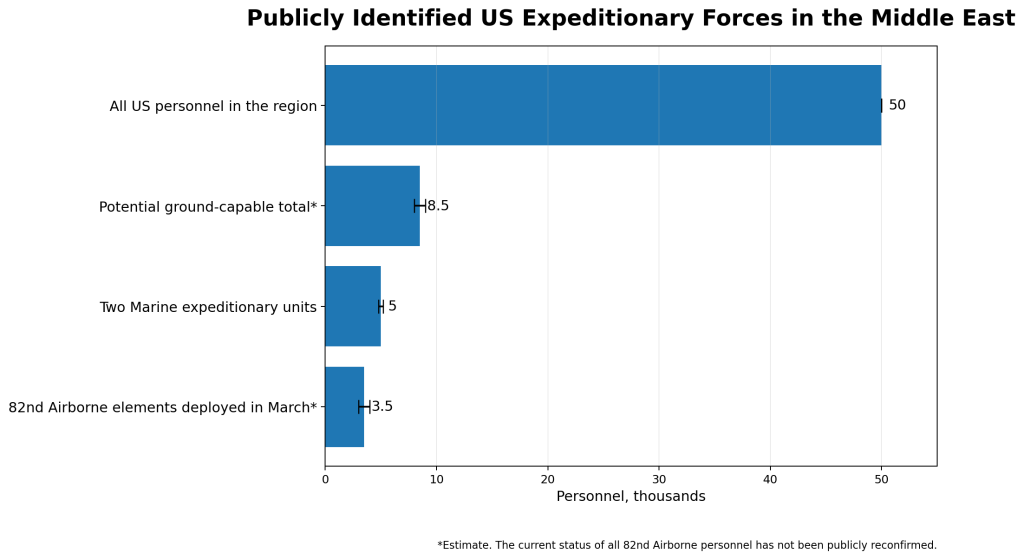
As of 17 July 2026, US Central Command said that more than 50,000 American service members were operating across the Middle East. This figure includes personnel serving with the Navy, Air Force, Army, Marine Corps, headquarters, intelligence, air defence and logistical units. It cannot therefore be treated as the size of a potential invasion force.
Based on publicly reported deployments, approximately 8,000 to 9,000 personnel can be associated with formations capable of supporting ground or amphibious operations:
- approximately 5,000 personnel in two Marine expeditionary units;
- between 3,000 and 4,000 soldiers from the 82nd Airborne Division deployed in March.
This is an analytical estimate rather than an official Pentagon figure. It also assumes that all the airborne forces deployed in March remain in the theatre—something the Pentagon has not publicly reconfirmed.
Not all of these personnel are infantry. Marine expeditionary units and airborne formations include aviation, command, medical, intelligence and logistical components alongside their ground combat elements.
Why the latest US targets matter
CENTCOM said its seventh consecutive night of attacks struck Iranian surveillance sites, military logistics infrastructure, underground weapons storage and maritime capabilities. Fighter aircraft, drones and warships were involved in the operation.
The selection of these targets may help reduce the risks facing future operations near Iran’s coastline. Disabling coastal radar, air defence, command networks, missile positions and naval capabilities could give US ships, helicopters, aircraft and landing forces greater freedom of movement.
This resembles the military process commonly described as shaping or preparing an operational environment. It does not, by itself, prove that a ground attack has been ordered.
The same targets are also relevant to an air campaign, a naval blockade, the protection of commercial shipping and the suppression of Iranian missile or drone attacks.
CENTCOM’s own assessment claims that during 38 days of major combat operations, US forces conducted more than 10,200 sorties and over 13,500 strikes. It also claims to have disabled much of Iran’s air-defence, missile-production and naval infrastructure. These are official US military assessments and have not all been independently verified.
Two Marine expeditionary units: approximately 5,000 personnel
The Tripoli Amphibious Ready Group, carrying the 31st Marine Expeditionary Unit, has been operating in the Arabian Sea. It was later joined by the Boxer Amphibious Ready Group and the 11th Marine Expeditionary Unit.
Reuters reported that the Boxer deployment included approximately 2,500 Marines and that its arrival would place two Marine expeditionary units in the region.
A Marine expeditionary unit is a self-contained force operating from amphibious ships. It normally combines:
- a battalion-sized ground combat element;
- helicopters, transport aircraft and combat aircraft;
- command and intelligence personnel;
- medical, engineering and logistical support.
The two units therefore provide roughly 5,000 expeditionary personnel, although the number of troops available for direct fighting ashore would be substantially smaller.
These forces are designed for crisis response. They could conduct a raid, seize a limited coastal objective, evacuate civilians, secure a port or airfield, board vessels or temporarily hold strategically important maritime terrain.
They are not configured to occupy a large country.
The 82nd Airborne deployment: 3,000 to 4,000 soldiers
In late March, Reuters reported that the Pentagon planned to send between 3,000 and 4,000 soldiers from the 82nd Airborne Division to the Middle East.
By 30 March, US officials said thousands of the division’s soldiers had begun arriving. The deployment reportedly included headquarters personnel, logistical and support elements and one brigade combat team. Officials said no decision had been made to send those soldiers into Iran, but that their presence would expand the options available for future operations.
The 82nd Airborne specialises in rapid deployment and forcible entry operations. Its units can seize and defend key infrastructure such as airfields, bridges and transport hubs until heavier follow-on forces arrive.
However, there has been no detailed public update confirming how many of the soldiers deployed in March remain in the Middle East in July. The 3,000-to-4,000 figure should therefore be treated as an upper-range public estimate, not a verified current count.
What could the present force accomplish?
The existing force could support several limited scenarios.
US officials have discussed deploying troops to Iran’s shoreline to help secure shipping through the Strait of Hormuz. Options involving Kharg Island—an important centre for Iranian oil exports—have also been considered. Reuters stressed that no decision to execute such an operation had been announced.
Potential missions within the capacity of the present force could include:
- a special-forces raid against a specific military or nuclear-related facility;
- the temporary seizure of an island;
- securing a limited section of coastline;
- capturing or destroying coastal missile and radar installations;
- holding an airfield, port or logistics centre for a short period;
- extracting personnel or sensitive material;
- supporting the enforcement of a naval blockade.
Such missions would rely heavily on air superiority, naval firepower, helicopters, drones and long-range precision weapons.
Even then, inserting forces would be easier than sustaining or withdrawing them. Iranian missiles, drones, artillery and dispersed ground formations could continue to threaten any position taken by US troops.
Why this is not an invasion force
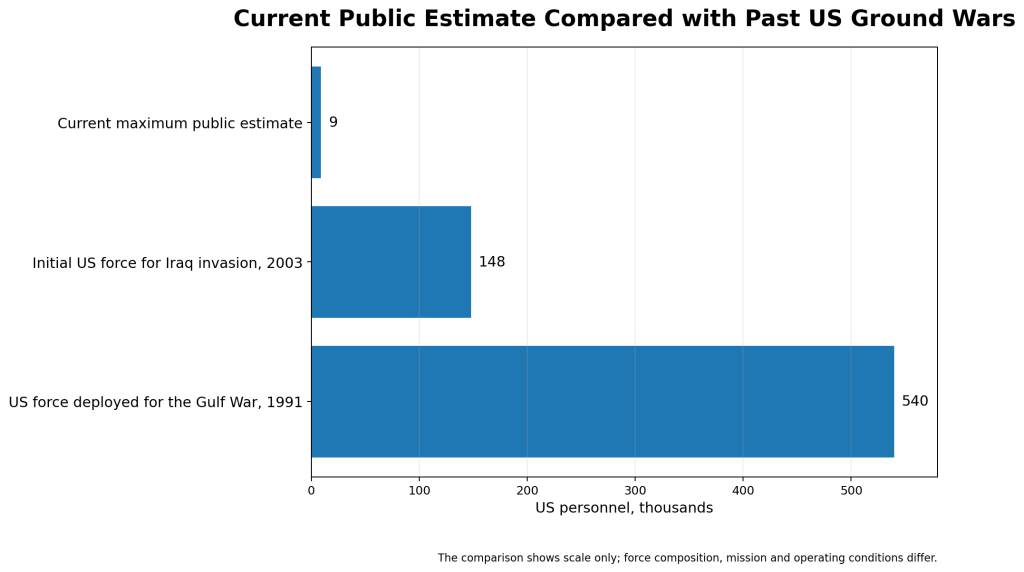
The maximum publicly identifiable estimate of approximately 9,000 expeditionary personnel is only around 6% of the 148,000 American troops involved in the initial 2003 invasion of Iraq.
The difference is even greater when compared with the 1991 Gulf War, during which the United States deployed approximately 540,000 military personnel. An official US Army medical history records the 540,000 figure for the Gulf deployment.
Iran also presents a more difficult operational environment than Iraq did in 2003. Its territory is around four times the size of Iraq, with mountain ranges, deserts, densely populated urban areas and long internal supply routes.
A major ground offensive would require far more than additional infantry. The United States would need:
- multiple Army and Marine divisions;
- armoured and mechanised formations;
- artillery and short-range air defence;
- combat-engineering and bridging units;
- large helicopter and transport-aircraft fleets;
- field hospitals and casualty-evacuation infrastructure;
- major fuel, ammunition and spare-parts stockpiles;
- secure ports, airfields and overland supply routes;
- sustained access to bases in neighbouring countries.
There is no public evidence, as of 18 July 2026, of a mobilisation on this scale.
CSIS assessed an earlier stage of the US build-up as sufficient for punitive strikes and regional defence but far smaller than the forces assembled for major combat and regime-change operations in 1991 and 2003. It compared the naval posture more closely with Operation Desert Fox, the limited 1998 bombing campaign against Iraq, than with Operation Desert Storm.
The subsequent arrival of Marines and airborne forces has expanded Washington’s options ashore. It has not transformed the force into an invasion army.
Naval strength is not the same as ground strength
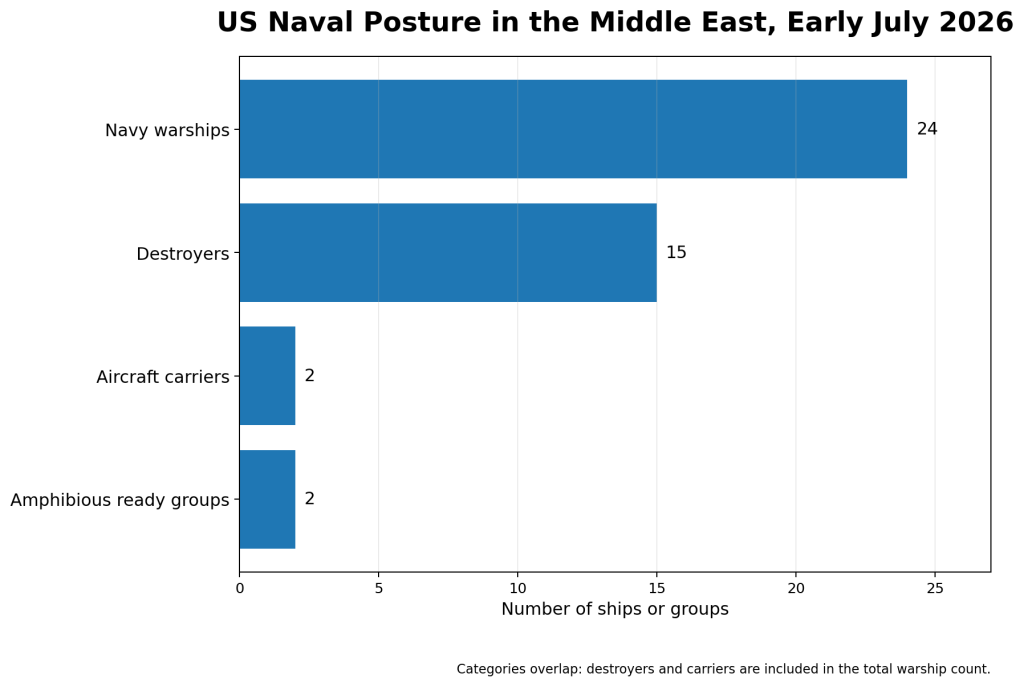
By early July, at least 24 US Navy warships were reported in the Middle East. These included two aircraft carriers and 15 destroyers, as well as two amphibious ready groups. The categories overlap: the carriers and destroyers are already included in the total number of warships.
This represents formidable air and missile power. Carrier aircraft, destroyers and submarines can strike targets, suppress air defences, protect landing forces and intercept Iranian missiles or drones.
But ships cannot capture and control territory by themselves. Naval strength may enable a limited landing, but it cannot replace the ground formations and logistical network required for a prolonged campaign inside Iran.
What would signal preparations for a wider ground war?
The assessment would change if open-source monitoring began to show several of the following developments:
- The deployment of multiple Army or Marine divisions rather than individual brigades or expeditionary units.
- Large-scale movement of tanks, armoured vehicles and self-propelled artillery.
- Activation of major strategic sealift and roll-on/roll-off transport ships.
- Construction of field hospitals and large casualty-treatment facilities.
- Major fuel, ammunition and equipment depots in Gulf states.
- Deployment of additional combat-engineering, bridging and logistics brigades.
- New basing or transit agreements with countries neighbouring Iran.
- Establishment of a dedicated land-component headquarters for operations inside Iran.
- A sustained increase in troops from tens of thousands to well above 100,000.
These preparations would be difficult to conceal completely. A force capable of invading Iran would require weeks or months of visible transportation and logistical activity.
Conclusion
The evidence supports the conclusion that the United States is preserving—and strengthening—the option of conducting a limited ground operation against Iran.
The combination of two Marine expeditionary units, airborne soldiers, special-operations capabilities, carrier strike groups and sustained attacks on Iranian coastal infrastructure could support raids, temporary territorial seizures or an operation against an island or coastal facility.
However, the current public force posture does not resemble preparations for the invasion or occupation of Iran.
Washington has assembled a powerful expeditionary force designed to create military options and political pressure. It has not yet assembled the army required to fight a major ground war across Iranian territory.