




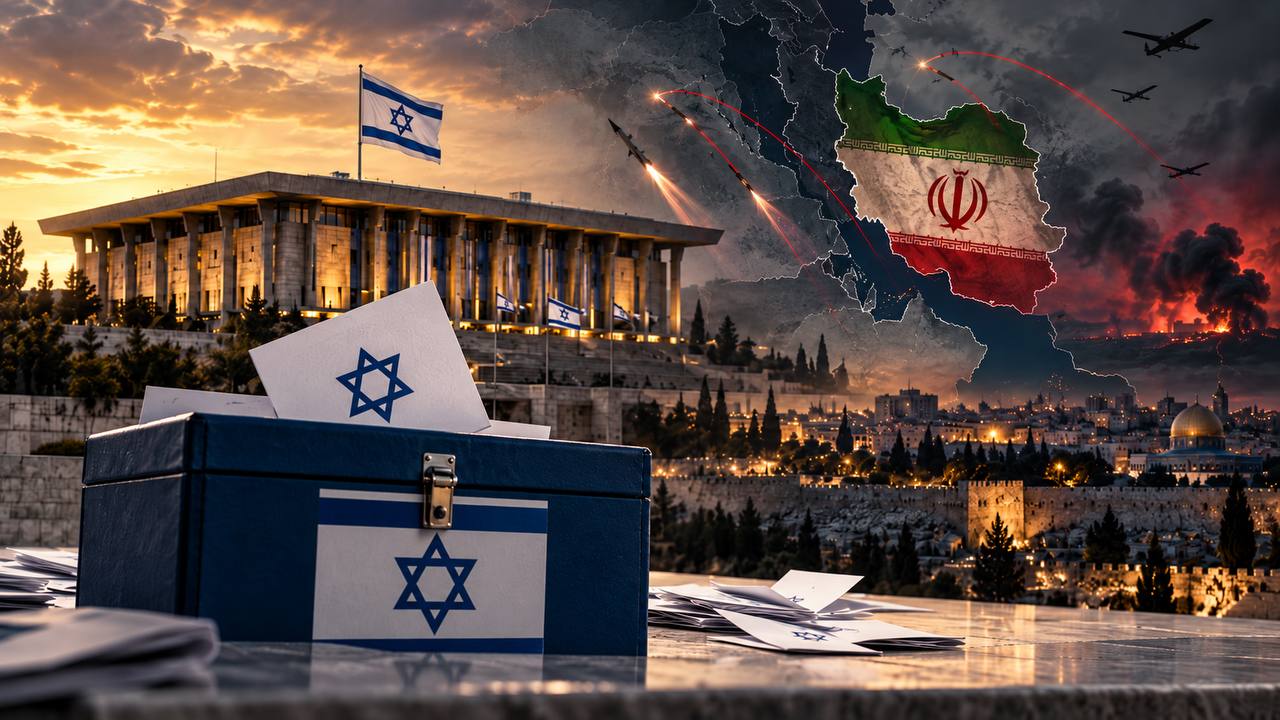

Israel’s parliamentary election on October 27 has produced a political paradox: Prime Minister Benjamin Netanyahu has retained his position as the leader of the largest political bloc, but his coalition has lost its parliamentary majority. Meanwhile, opposition leader Gadi Eisenkot has demonstrated substantial electoral support without securing a straightforward path to government.
Preliminary results indicate that Netanyahu’s bloc holds approximately 53 seats, Eisenkot’s opposition bloc 48, and Arab-led parties 19 in the 120-member Knesset. Neither major bloc has independently reached the 61-seat threshold required for a parliamentary majority.
Yet the significance of this electoral deadlock extends far beyond Israel’s domestic politics.
At a moment when the Middle East remains caught in the consequences of the US-Israeli war against Iran, the absence of a decisive electoral outcome raises a question with profound regional implications: Could Israel’s political uncertainty encourage another military escalation, or create an opportunity for diplomacy?
The answer depends not simply on who becomes Israel’s next prime minister, but on the interaction between domestic political survival, military deterrence, American strategic priorities, and Iran’s response to continued pressure.
Israel’s election was the first national vote since the Hamas-led attacks of October 7, 2023, and the subsequent wars in Gaza, Lebanon, and Iran.
The campaign reflected deep divisions over Netanyahu’s leadership, accountability for Israel’s security failures, military conscription, and the country’s international standing.
However, the electoral contest revealed significantly less disagreement over Israel’s central security assessment: that Iran represents a long-term strategic threat.
Both Netanyahu and Eisenkot support preventing Iran from acquiring nuclear weapons and preserving Israel’s ability to employ military force against emerging threats.
Their differences concern the objectives, scope, and political management of military operations.
Netanyahu has increasingly framed the confrontation as an opportunity to eliminate the Iranian threat permanently. His rhetoric has also extended to the possibility of fundamentally transforming Iran’s political and military capabilities.
Eisenkot, a former chief of the Israeli military, supports maintaining military pressure on Iran but has placed greater emphasis on clearly defined security objectives, institutional decision-making, and the relationship between military operations and diplomatic outcomes.
This distinction is important.
A change in government would not necessarily reverse Israel’s military posture towards Tehran. It could, however, alter the conditions under which Israel chooses to escalate, the objectives it pursues, and its willingness to accept a negotiated settlement.
The election therefore represents less a choice between confrontation and reconciliation than a debate over how confrontation should be managed.
The direct military confrontation that began with US and Israeli strikes against Iran on February 28, 2026, transformed a decades-long shadow conflict into an interstate war.
Subsequent ceasefire arrangements and diplomatic initiatives temporarily reduced large-scale hostilities, but failed to establish a durable political settlement.
The conflict has exposed the limitations of traditional deterrence.
For Israel, military operations have demonstrated the possibility of striking Iranian infrastructure directly. Yet the destruction of military facilities does not automatically eliminate the political decisions, technological capabilities, or strategic incentives underlying Iran’s nuclear and missile programmes.
For Tehran, the war has illustrated the costs of direct confrontation with Israel and the United States. At the same time, Iran retains instruments of retaliation, including missile capabilities, regional armed partners, and the ability to threaten maritime commerce.
This creates a security dilemma.
Israeli efforts to prevent Iran from rebuilding its military capabilities may be interpreted in Tehran as preparation for continued coercion or further attacks. Iranian attempts to restore deterrence can, in turn, be regarded by Israel as evidence that another pre-emptive operation is necessary.
Under such conditions, the absence of a diplomatic framework can allow a temporary military pause to become merely the interval before another confrontation.
Netanyahu’s immediate challenge is parliamentary arithmetic.
Although Likud remains the largest party, his previous coalition no longer commands a majority. Forming another government would require either attracting new partners, negotiating with political opponents, or obtaining sufficient parliamentary support through alternative arrangements.
Until a government is formed, Netanyahu remains caretaker prime minister.
This situation introduces an important intersection between domestic politics and national security.
Israeli constitutional practice generally requires caretaker governments to exercise restraint in major decisions. Nevertheless, their formal executive powers remain substantial, particularly in urgent national security matters.
Legal specialists interviewed by Reuters have argued that a caretaker administration can retain the authority to authorise major military action, including operations against Iran, when justified by security circumstances.
Political uncertainty therefore does not necessarily mean military paralysis.
Indeed, a new confrontation could increase pressure for a national unity government. Conversely, launching a major operation without broad political support could intensify disputes over the legitimacy and accountability of the caretaker administration.
Eisenkot has warned against the possibility that security decisions could be influenced by political considerations. Netanyahu’s office has rejected allegations that the Iran conflict is being used for political advantage.
There is insufficient evidence to establish that renewed military action would be driven by coalition calculations. Nevertheless, the overlap between political negotiations and security decision-making creates a risk that military developments could influence the balance of power inside Israel.
Perhaps the most consequential external actor is the United States.
The Israeli election has taken place only days before the American midterm elections scheduled for November 3.
President Donald Trump publicly supported Netanyahu during the Israeli campaign and has repeatedly presented the confrontation with Iran as a central element of his Middle East policy.
However, Washington faces competing incentives.
On one side, American policymakers seek to prevent Iran from restoring capabilities that could threaten Israel, American forces, and regional partners.
On the other, the economic and political consequences of the war have become increasingly difficult to ignore.
Disruptions to maritime trade, rising energy prices, military expenditures, and instability across the Gulf have increased the costs of prolonged confrontation.
The United States must therefore weigh the potential military benefits of renewed strikes against their economic consequences and the prospects for a diplomatic settlement.
American and Israeli strategic objectives are closely aligned, but they are not necessarily identical.
Washington may accept a verifiable arrangement limiting Iran’s nuclear programme even if some Israeli political leaders consider that agreement insufficient.
Alternatively, renewed American military operations could create strong incentives for any Israeli government, regardless of its composition, to participate in or support the campaign.
For this reason, developments in Washington after November 3 could have as much influence over the next phase of the Iran conflict as the outcome of coalition negotiations in Jerusalem.
From Tehran’s perspective, Israel’s inconclusive election presents both uncertainty and potential diplomatic opportunities.
Iranian decision-makers must consider several possible Israeli political configurations, none of which guarantees a fundamental relaxation of military pressure.
A Netanyahu-led government retaining its nationalist allies could pursue more expansive military objectives.
A broader coalition might prioritise institutional consensus and closer coordination with Washington.
An Eisenkot-led administration could maintain an assertive military posture while defining the strategic objectives of confrontation differently.
Yet Iranian policy also influences these outcomes.
In late October, Qatar presented a new proposal intended to move the United States and Iran towards an agreement ending the conflict. According to Reuters, Iranian officials regarded the proposals as unacceptable, although Foreign Minister Abbas Araqchi indicated that diplomatic contacts would continue.
The central disagreement concerns the sequencing of concessions.
Washington wants Iran’s nuclear programme addressed from the beginning of negotiations. Tehran has insisted that restrictions on its oil exports and the blockade affecting its ports must be addressed first.
These competing demands illustrate why military pressure alone may not produce a stable settlement.
If Tehran interprets Israeli political fragmentation as an opportunity to delay concessions, negotiations could stagnate. Conversely, if Iranian leaders conclude that further escalation would impose unacceptable military and economic costs, they may have stronger incentives to pursue a verifiable agreement.
Neither response is inevitable.
The determining factors will include Iran’s assessment of American intentions, the credibility of security guarantees, and the economic consequences of continued confrontation.
The post-election environment presents three broad possibilities for the future of the Israel-Iran conflict.
A new round of major attacks could emerge if Israeli or American leaders conclude that Iran is rebuilding capabilities they consider unacceptable, or if a regional incident triggers a wider confrontation.
Such escalation could involve Iranian military infrastructure, missile-related facilities, or other strategic targets.
The danger would not be limited to Israel and Iran. Retaliation could affect Gulf states, shipping routes, energy facilities, and conflicts involving Iran-aligned armed groups.
The Strait of Hormuz and the Bab el-Mandeb would remain especially significant because disruption in either maritime corridor could transmit the consequences of regional conflict to international energy markets.
A second possibility is a prolonged period of limited military exchanges, intelligence operations, economic pressure, and intermittent diplomacy.
This would resemble an unstable form of deterrence rather than a comprehensive peace.
Both Israel and Iran could seek to preserve military leverage while avoiding the full economic and strategic costs of another large-scale campaign.
However, such a situation would remain vulnerable to miscalculation. An individual strike, intelligence assessment, or attack by a regional armed group could trigger escalation beyond the original intentions of the parties involved.
A third possibility involves an agreement combining restrictions and verification of Iran’s nuclear activities with sanctions-related concessions, maritime security measures, and mechanisms to reduce regional hostilities.
Such an arrangement would require concessions from Tehran and Washington, while Israel would need sufficient confidence that the agreement addressed its principal security concerns.
A diplomatic settlement would not automatically resolve the broader conflict between Israel and the Islamic Republic.
Nevertheless, a credible verification mechanism and enforceable commitments could reduce the frequency and intensity of military confrontation.
The main obstacle remains the absence of sufficient trust and agreement over what an acceptable end state should look like.
The most important consequence of Israel’s election may be the uncertainty it introduces into the timing and management of future security decisions.
An inconclusive election does not remove Israel’s capacity to conduct military operations. Nor does a change in political leadership necessarily imply a reversal of its strategic doctrine.
Instead, the electoral deadlock creates multiple centres of political pressure at precisely the moment when decisions over Iran require clear strategic objectives.
Four developments deserve particular attention in the coming weeks: the composition of Israel’s next coalition, the American administration’s decisions after the midterms, progress in negotiations mediated by Qatar and Pakistan, and evidence of renewed military preparations or significant Iranian concessions.
The interaction of these developments will provide a more meaningful indication of the region’s direction than the Israeli election results alone.
Israel’s October 2026 election has not delivered a decisive parliamentary mandate. It has, however, demonstrated the persistence of a broad national security consensus regarding Iran.
The next government’s identity will matter, particularly in determining the objectives and diplomatic limits of military operations. Yet Israel’s approach will also be shaped by its security institutions, American decision-making, Iranian actions, and the broader regional balance of power.
For the Middle East, the danger lies in the possibility that a fragmented political system could coexist with an increasingly rapid cycle of military decision-making.
A renewed war is not an automatic consequence of Netanyahu’s political survival, just as an alternative government would not guarantee de-escalation.
Ultimately, the decisive question is not simply who governs Israel, but whether Israel, Iran, and the United States can move from an unstable system of military coercion towards a security arrangement capable of preventing another major regional escalation.
Until that question is resolved, Israel’s political uncertainty will remain one element of a much larger geopolitical crisis.