




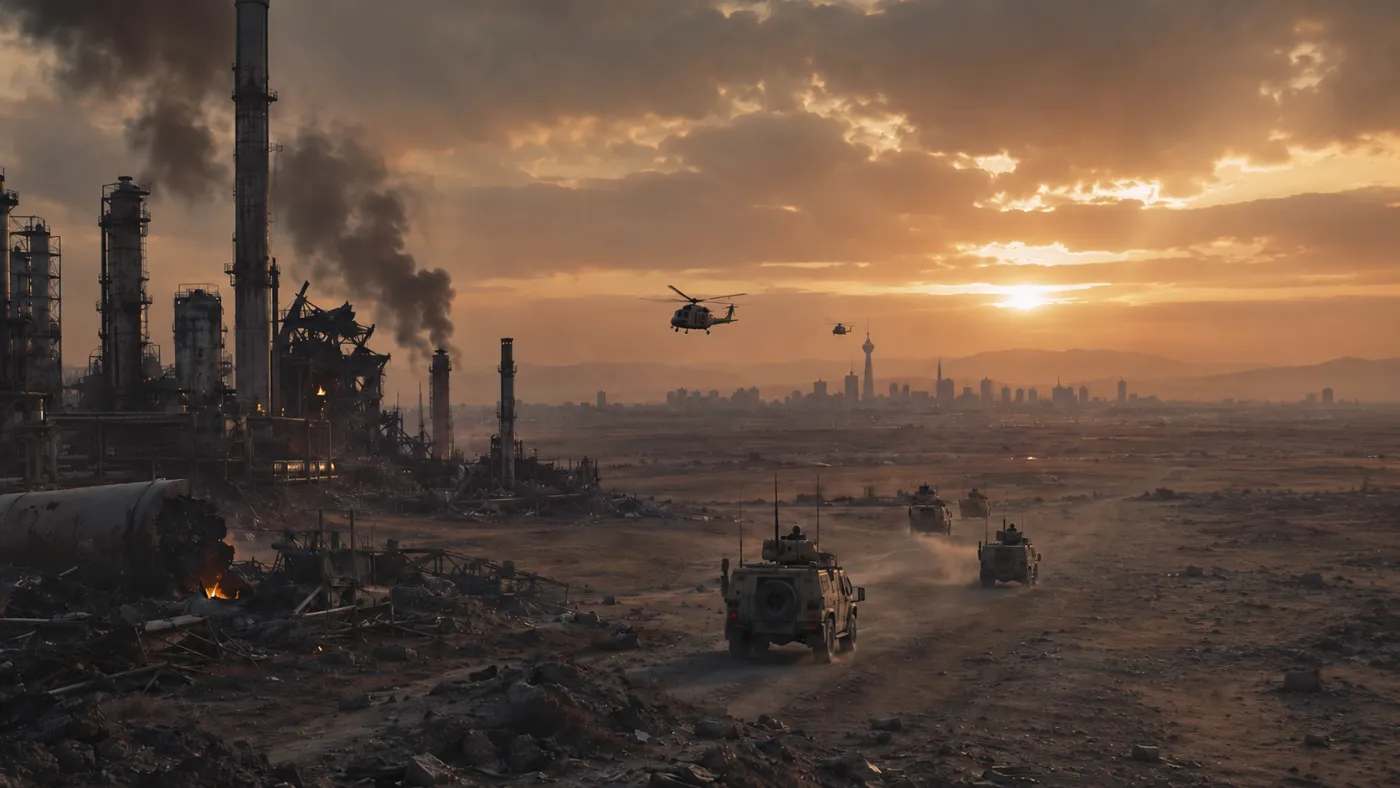

In international politics, defeat does not always look like surrender. It does not always come with a fallen capital, a defeated army, or a signed document of capitulation. Sometimes defeat appears in a more ambiguous form: a great power unleashes overwhelming military force, promises strategic transformation, and then finds itself negotiating with the very regime it claimed it would coerce, contain, or possibly overthrow.
This is the central paradox of America’s latest war with the Islamic Republic. The United States and Israel inflicted serious damage on Iran’s military infrastructure. Iranian missile depots, drone facilities, naval assets, air defences, and command structures were hit. Yet wars are not judged merely by the number of targets destroyed. They are judged by whether military force produces the political outcome it was designed to achieve.
By that measure, Washington’s success is far less convincing.
President Donald Trump entered the war with expansive objectives: to neutralise Iran’s nuclear ambitions, degrade its missile and drone capabilities, weaken its regional network of proxies, restore American deterrence in the Middle East, and, at least rhetorically, open the way for political change in Tehran. Months later, the Islamic Republic remains in power. The nuclear question is unresolved. Iran’s regional networks have not disappeared. The Strait of Hormuz has again proved to be a strategic vulnerability for the global economy. And Washington, after months of escalation, is now pursuing a negotiated framework with Tehran.
This is not how imperial awe is maintained.
The United States remains the most powerful military actor in the world. No regional state can match its global reach, air power, intelligence capabilities, or naval dominance. But military capacity is not the same as political authority. The image of American power in the Middle East has always rested not only on its ability to destroy, but on its presumed ability to shape outcomes. What is breaking now is not America’s ability to bomb; it is the belief that bombing can still impose a sustainable political order.
For many in the Middle East, this war fits a familiar pattern: overwhelming American entry, dramatic military strikes, ambitious political promises, and then an exit or agreement that falls short of the original objective. Afghanistan, Iraq, Syria, and now Iran have all contributed to a regional memory in which American force is feared but no longer necessarily believed. The United States can still punish. It can still disrupt. But it increasingly struggles to convert destruction into durable political success.
This distinction matters. In the academic literature on coercive diplomacy, military force succeeds only when it changes the adversary’s behaviour in a politically meaningful way. Robert Pape’s classic work on air power and coercion argues that bombing is often ineffective when it is used merely to punish or pressure an enemy’s will. Coercion works best when it denies the adversary the ability to pursue its strategy, not simply when it raises the cost of doing so. In Iran’s case, the United States raised the cost of confrontation. It did not destroy the regime’s strategic logic.
The Islamic Republic understands this. For Tehran, survival itself can be transformed into victory. A regime built on the mythology of resistance does not need to prove that it defeated America militarily. It only needs to prove that America failed to make it surrender. If Iran can say it endured direct American and Israeli attacks, struck regional states, disrupted energy infrastructure, threatened the Strait of Hormuz, and still forced Washington back to the negotiating table, then the regime has a powerful narrative of victory.
This is why the emergence of a younger, more aggressive leadership in Tehran could become one of the most dangerous consequences of the war. A post-war Islamic Republic may be economically exhausted and institutionally damaged, but it may also be more radical in its strategic psychology. The lesson it draws may not be caution. It may be the opposite: that even direct American military intervention cannot bring the regime down.
That lesson will not remain inside Iran. It will travel across the region.
For the Arab Gulf states, the war has exposed a profound strategic dilemma. For decades, their security architecture has rested on two assumptions: first, that the United States can deter Iran; second, that American military presence can prevent regional conflict from reaching their own territory and energy infrastructure. Iran’s attacks on regional targets and energy systems weakened both assumptions. A security order that cannot protect oil facilities, shipping lanes, ports, and civilian infrastructure in moments of crisis begins to lose its credibility.
This does not mean Gulf states will abandon America. They will continue to buy American weapons, host American forces, and depend on American intelligence and defence technology. But they will hedge more openly. They will deepen channels with China. They will maintain working relations with Russia. They will avoid completely closing diplomatic doors to Tehran. This is the meaning of a post-American Middle East: not the disappearance of America, but the decline of unquestioned confidence in America as the final guarantor of regional order.
The psychological effect may be even more important than the strategic one. In the Middle East, perception often becomes power. If ordinary people across the region see the United States attack Iran and then seek an agreement with the same regime, many will interpret that not as pragmatic diplomacy but as a retreat from maximalist ambition. Whether this interpretation is legally or militarily precise is almost irrelevant. Politics in the region is shaped by narratives, symbols, and memories of humiliation and defiance.
The Islamic Republic is highly skilled at exploiting such ambiguity. It can absorb material damage and turn political survival into ideological capital. It can tell its supporters that the world’s greatest military power could not impose surrender. It can tell its proxies that resistance works. It can tell its domestic opponents that the country remains under external siege. And it can use the language of national defence to justify repression, censorship, arrests, and the further militarisation of society.
This is another danger of the war. Instead of weakening the Islamic Republic from within, it may give the regime new tools to discipline society. A government facing deep economic crisis, legitimacy collapse, generational anger, and public exhaustion can use war as a mechanism of political consolidation. Internet restrictions, emergency laws, security trials, and suppression of dissent can all be reframed as necessary wartime measures. In this sense, an unfinished American war may become a domestic gift to the regime.
For Washington, the problem is not that diplomacy is wrong. A negotiated framework may be necessary to reopen the Strait of Hormuz, stabilise energy markets, prevent regional escalation, and reduce the risk of a longer war. But when diplomacy follows maximalist threats and inconclusive military action, it carries a different meaning. It looks less like strategic choice and more like strategic retreat.
That is the heart of America’s crisis in the Middle East. Washington wants to demonstrate military dominance while avoiding endless war. It wants to reassure allies while reducing exposure. It wants to punish Iran while negotiating with it. It wants to weaken the Islamic Republic while preventing regional collapse. These goals are not always compatible. The more America relies on spectacular force and then settles for limited political outcomes, the wider the gap becomes between the image of power and the reality of influence.
For Iran, that gap is an opportunity. The Islamic Republic may not have won the war in a conventional military sense. It has suffered losses. Its infrastructure has been damaged. Its economy remains fragile. Its society remains deeply alienated from the ruling system. But if it emerges from this war alive, more defiant, still armed, still repressive, and still treated as a necessary negotiating partner by Washington, then it can claim something more valuable than battlefield victory: political survival against American power.
And in the Middle East, survival against America can be sold as victory.
The real question, then, is not how many Iranian targets the United States destroyed. The real question is what kind of region remains after the bombs stop falling. If the result is a surviving Islamic Republic, anxious Arab allies, an unsatisfied Israel, a still-vulnerable Strait of Hormuz, and an American administration searching for a deal, then Tehran will have achieved a significant political gain from a devastating war.
This is how American awe breaks: not because the United States becomes weak, but because its strength no longer produces clear political results. The Islamic Republic may not have defeated America militarily. But if Washington leaves the region without victory and returns to negotiation with a younger, harsher, and more aggressive Tehran, then the regime has won where it matters most: in the battle over meaning.
In the Middle East, the narrative of victory is often part of victory itself.