




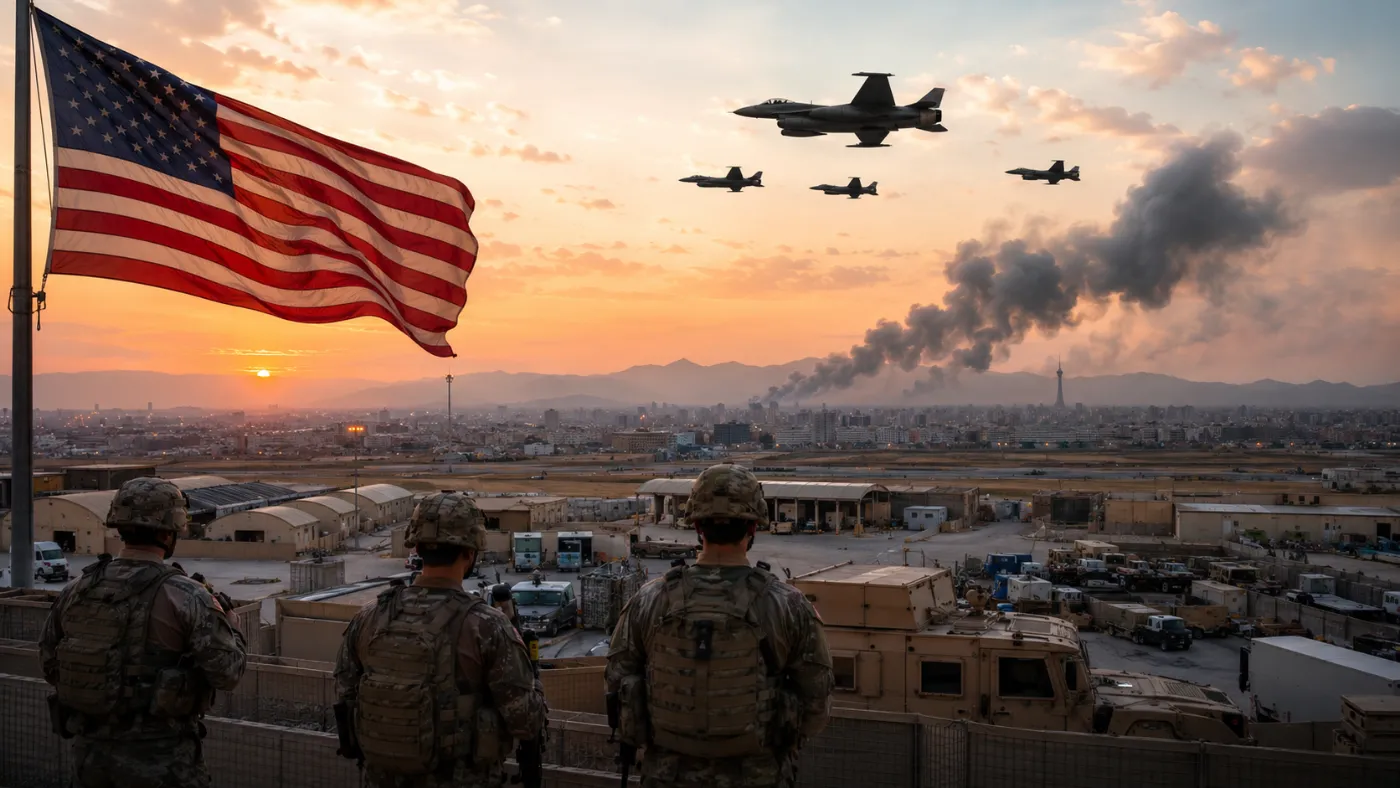

The Iran–U.S. war of 2026 cannot be understood only through diplomacy, political statements, or competing propaganda narratives. It was also a data-heavy conflict: tens of thousands of American troops were positioned across the region; hundreds of aircraft and support platforms were involved in major operations; thousands of sorties were flown; thousands of strikes were conducted; and key parts of Iran’s military-industrial infrastructure were targeted.
Yet the data must be handled carefully. Most of the publicly available numbers come from U.S. official sources, including CENTCOM, Pentagon briefings, and news reports citing American officials. They therefore represent the public U.S. account of the war, not necessarily a complete or independently verified picture of the battlefield. Still, even this public record is enough to show the scale of the conflict. The 2026 war was not a symbolic exchange of fire. It was a broad, expensive, multi-domain military campaign.
1. U.S. troop presence: a return to war footing in the Middle East
The first sign of the war’s seriousness was the scale of the American manpower footprint in the region. According to Reuters, before a new reinforcement was announced, roughly 50,000 U.S. troops were already deployed in the Middle East. American officials then indicated that another 3,000 to 4,000 soldiers could be sent, raising the regional footprint to roughly 53,000 to 54,000 troops.
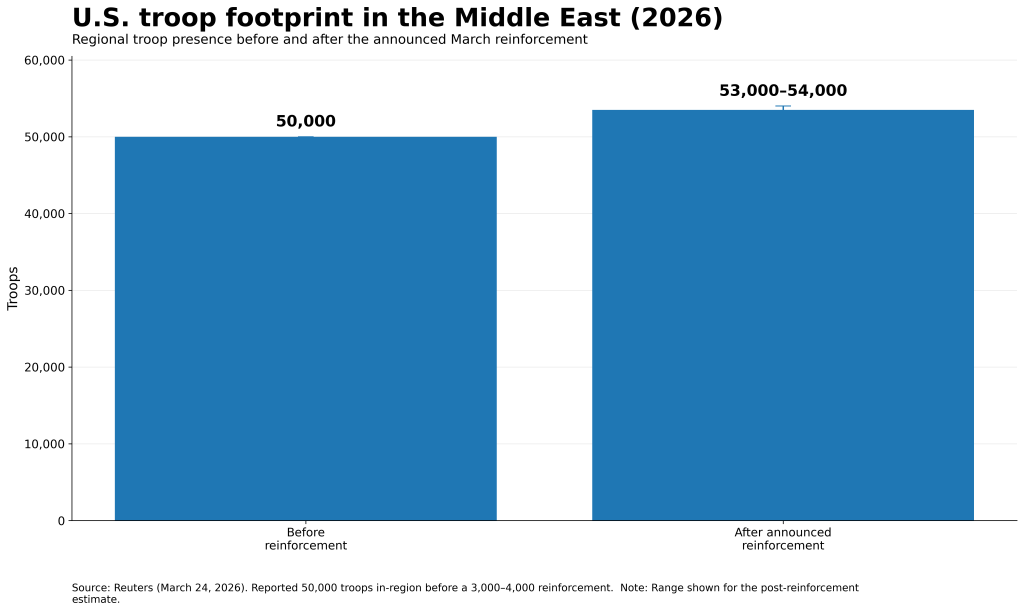
This number matters for several reasons. First, it shows that the United States was not operating in a merely symbolic or punitive mode. A 50,000-strong regional posture means active bases, air-defense networks, naval units, air assets, intelligence teams, logistics systems, and command structures. Second, the decision to add more troops during the crisis suggests that Washington was preparing for possible escalation, Iranian retaliation, or further military operations.
At the same time, this was not a classic American ground war. In Operation Desert Storm in 1991, the United States deployed more than half a million troops. In the 2003 invasion of Iraq, around 250,000 American personnel were involved. By comparison, the 2026 war was not an occupation campaign. But it was also much larger than a limited airstrike. It occupied a dangerous middle ground: bigger than a punitive raid, smaller than a full-scale invasion, but costly enough to create long-term military and political pressure.
2. Operation Midnight Hammer: America’s technological display of force
One of the defining moments of the war was Operation Midnight Hammer, which the Pentagon described as a precise and complex strike against three Iranian nuclear facilities: Fordow, Natanz, and Esfahan. According to the Pentagon’s public briefing, the operation involved seven B-2 Spirit bombers, more than 125 aircraft, more than two dozen Tomahawk cruise missiles, 14 GBU-57 Massive Ordnance Penetrator bombs, and about 75 precision-guided weapons.
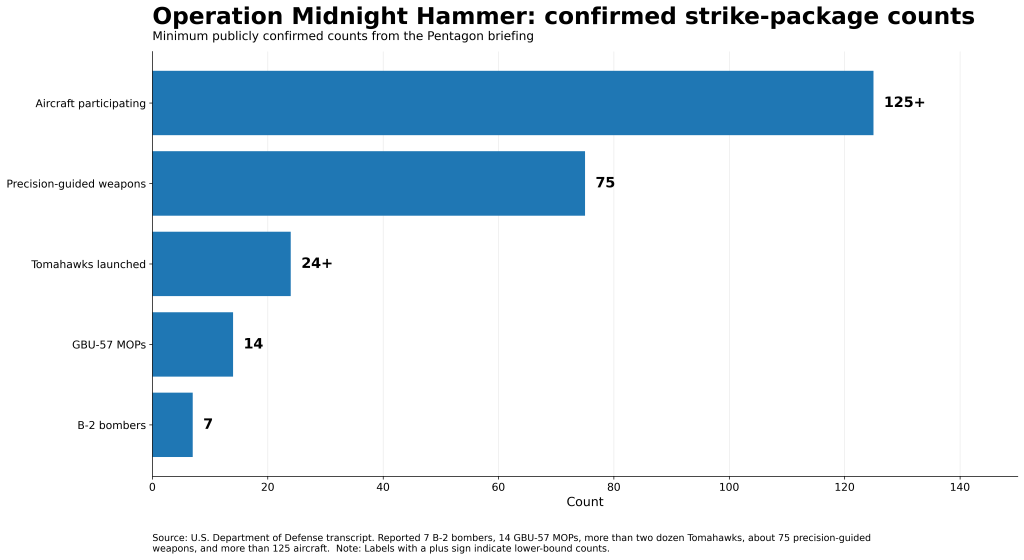
The importance of this operation was not only the number of weapons used. Its significance lay in the message it was meant to send. Washington wanted to demonstrate that it could still strike the most sensitive targets inside Iran using a combination of stealth bombers, cruise missiles, support aircraft, refuelling tankers, intelligence platforms, and advanced command-and-control systems. The use of B-2 bombers and GBU-57 bunker-buster bombs showed that the target set was not merely surface infrastructure, but hardened and deeply buried facilities.
But this operation also raises a larger question: is technological superiority the same as strategic success? The data suggests a more complicated answer. The United States demonstrated its capacity for long-range, high-precision destruction. But the war did not end after Midnight Hammer. The Islamic Republic did not collapse. The nuclear issue was not fully resolved. And Washington still needed diplomacy to manage the crisis. Militarily, Midnight Hammer was a major operation. Politically, it did not end the conflict.
3. Operation Epic Fury: war as a campaign of attrition
If Midnight Hammer symbolised precision and shock, Operation Epic Fury reveals the broader logic of attrition. According to CENTCOM’s public posture statement, U.S. forces flew 10,200 sorties and carried out 13,500 strikes during the operation.
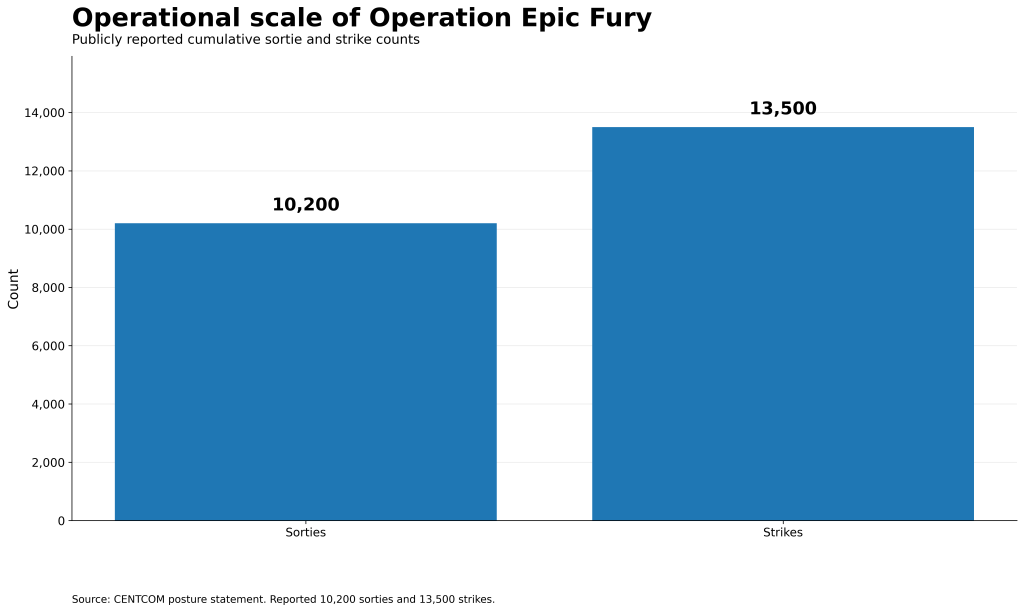
These figures show that the war had gone far beyond a limited series of strikes. More than 10,000 sorties imply a vast operational network: fighters, bombers, refuelling aircraft, surveillance platforms, drones, command aircraft, and support systems. More than 13,000 strikes indicate a sustained campaign to degrade Iran’s military power over time.
This pattern is familiar in recent American military history. In Afghanistan, Iraq, Syria, and Libya, the United States repeatedly used airpower, intelligence, and technological superiority to raise the cost of enemy behaviour. But history also shows that airpower can destroy infrastructure without necessarily changing the political logic of the adversary. In Iran’s case, the key question is not only how many targets were struck. It is whether those strikes changed the strategic behaviour of the Islamic Republic — or merely raised the cost of its survival.
4. Target sets: beyond the nuclear file
One of the most important features of the CENTCOM data is the diversity of targets. According to the public figures, U.S. forces carried out 1,450 strikes on weapons-manufacturing facilities, more than 450 strikes on ballistic-missile storage and systems, roughly 800 strikes on drone-launching units and storage sites, and more than 700 strikes on naval-mine targets.
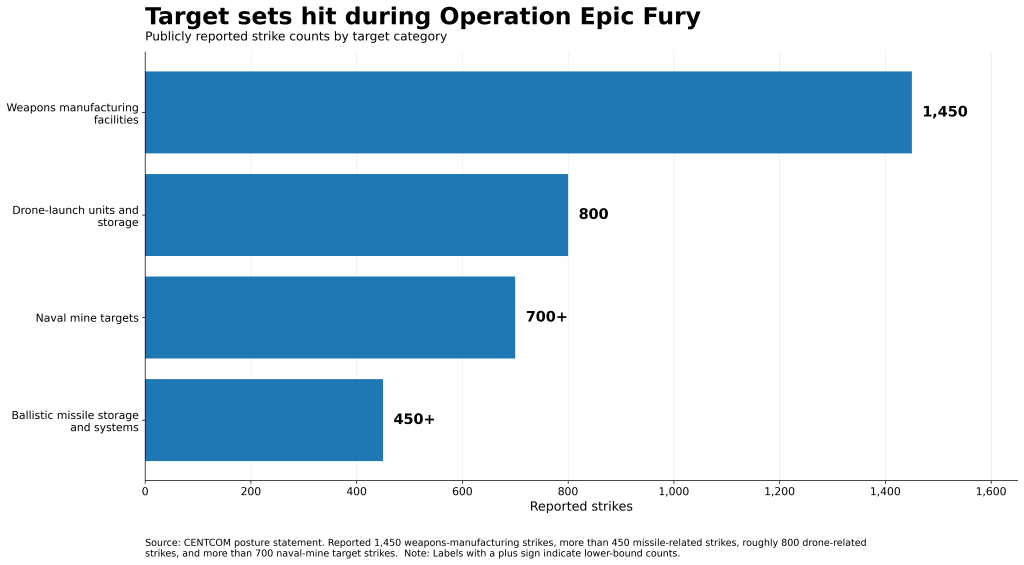
This distribution of targets shows that the U.S. strategy was not limited to Iran’s nuclear programme. Washington was also targeting three pillars of the Islamic Republic’s asymmetric deterrence: missiles, drones, and maritime disruption.
These three areas are central to Iran’s regional strategy. Missiles allow Tehran to threaten Israel, U.S. bases, and Gulf states. Drones provide a cheaper, flexible tool for asymmetric warfare. Naval mines and maritime harassment capabilities allow Iran to threaten the Strait of Hormuz and global energy flows.
In that sense, the 2026 war can be understood as an attempt to break the architecture of Iran’s asymmetric deterrence. The United States was not merely targeting buildings or depots. It was trying to reduce Iran’s ability to threaten the region, disrupt energy markets, and preserve leverage through unconventional military tools.
But here again, there is a gap between physical destruction and political transformation. Even if a large portion of Iran’s military infrastructure was damaged, the Islamic Republic may still be able to rebuild through dispersed production, underground facilities, hidden stockpiles, proxy networks, and gradual adaptation. The data on target sets must therefore be read alongside the regime’s capacity for reconstitution.
5. Damage assessments: the official U.S. account of military degradation
According to CENTCOM’s public assessment, the campaign damaged or destroyed more than 85 percent of Iran’s ballistic-missile, drone, and naval-defense industrial base. It also knocked out 82 percent of Iran’s air-defense missile systems and eliminated more than 90 percent of Iran’s naval-mine inventory.
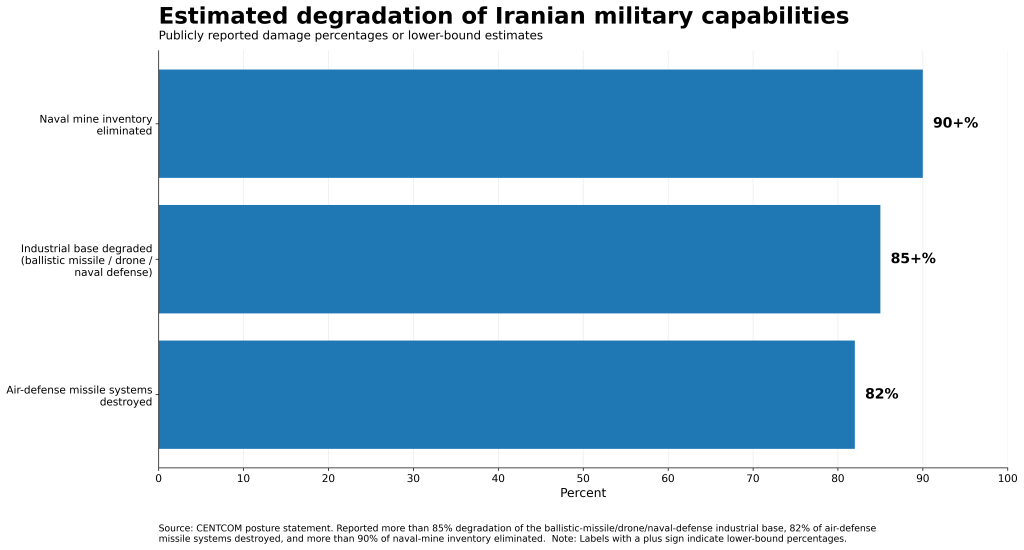
If accurate, these numbers carry serious military significance. The destruction of 82 percent of air-defense missile systems would make Iranian airspace far more vulnerable to follow-on strikes. Damage to more than 85 percent of the missile, drone, and naval-defense industrial base could slow Iran’s ability to produce, maintain, and replace key weapons systems. The elimination of more than 90 percent of naval mines would directly affect Iran’s ability to threaten the Strait of Hormuz.
But caution is essential. These are official U.S. assessments. In war, battle-damage assessments are often uncertain, especially in the early stages. The Pentagon itself has acknowledged in other contexts that final damage assessments can take time. These figures should therefore be read as the official U.S. account of degradation, not as a fully independent battlefield audit.
Still, even with that caution, the direction of the data is clear: the 2026 war inflicted serious damage on parts of Iran’s military infrastructure. The larger question is whether military damage translated into political defeat. That is much harder to prove.
6. Maritime warfare and the cost of controlling energy routes
Another important figure is the reported destruction of 161 Iranian vessels, attributed by CENTCOM to U.S. operations against Iran’s maritime capabilities.
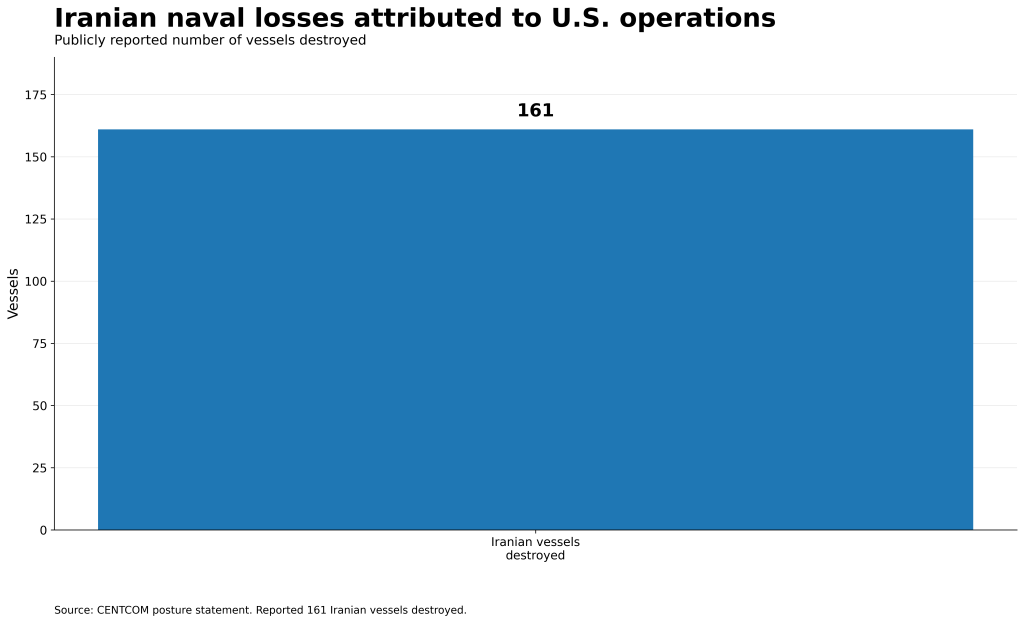
This number must be understood in the context of the Strait of Hormuz. The Islamic Republic has long known that it cannot defeat the U.S. Navy in a conventional naval war. Its maritime strategy is therefore built around asymmetric disruption: fast boats, mines, drones, shore-based missiles, harassment tactics, and psychological pressure on shipping and insurance markets.
The goal is not to win a classic naval battle. The goal is to raise the cost of securing global energy flows.
From that perspective, the destruction of 161 vessels is significant, but it does not necessarily end Iran’s maritime threat. Tehran does not need a large blue-water navy to create instability in the Gulf. Small boats, mines, drones, and coastal missiles can be enough to increase risk, raise insurance costs, disrupt commercial routes, and force the United States into an expensive protection mission.
This is why the maritime dimension of the 2026 war was not only military. It was also economic and psychological. Washington wanted to prove that it could keep energy routes open. Tehran wanted to prove that it could make energy security expensive.
7. Daily cost: war is not measured only in bombs
The financial cost of maintaining troops in a war posture is another important part of the data story. There is no public, war-specific official figure for the daily cost of U.S. troops in the 2026 Iran conflict. For that reason, the cost chart uses a transparent proxy: the Congressional Budget Office estimated that deploying 1,000 National Guard personnel in 2026 would cost between $18 million and $21 million per month. Using the lower bound of $18 million per month, the daily cost comes to roughly $600,000 per 1,000 troops.
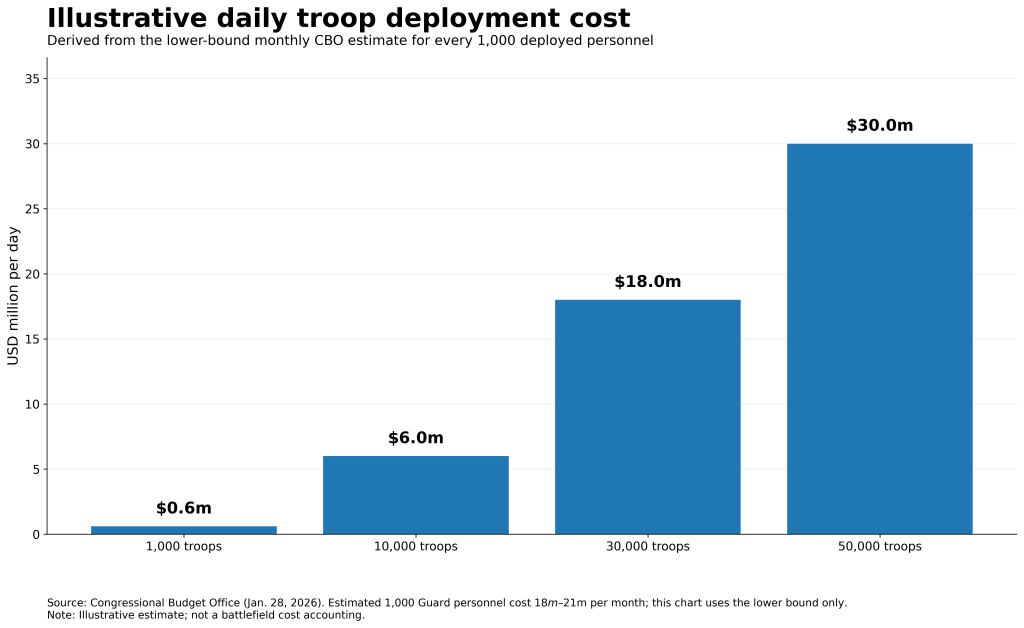
On that basis, 10,000 troops would cost roughly $6 million per day; 30,000 troops roughly $18 million per day; and 50,000 troops roughly $30 million per day. These figures do not represent the full cost of the war. They do not include the cost of munitions, aircraft maintenance, fuel, naval deployments, intelligence operations, medical care, air defense, replenishment of depleted weapons stocks, or support for allies.
Even so, the estimate shows that simply keeping forces deployed and ready can cost millions of dollars every day. This matters politically. Long wars in the Middle East have repeatedly triggered domestic debates in the United States over cost, purpose, legality, and strategic outcome. The longer the conflict continues without a clear political result, the more pressure builds in Washington.
8. Conclusion: military power and the crisis of political outcome
Taken together, the charts tell a double story.
On one hand, the data shows the enormous scale of American military power: tens of thousands of troops in the region, more than 125 aircraft in a single major strike package, 10,200 sorties, 13,500 strikes, hundreds of attacks on missile, drone, and naval targets, and severe reported damage to Iranian military infrastructure.
On the other hand, the same data raises a deeper strategic question: did this military power produce a clear political outcome?
If the Islamic Republic survives the war, retains part of its coercive capacity, continues to disrupt the region, and eventually forces Washington back into diplomacy, then the war cannot be understood only through the language of military success. The United States may have destroyed targets. It may have degraded capabilities. It may have demonstrated overwhelming technological superiority. But the central issue remains whether military destruction produced strategic submission.
For Tehran, the gap between physical damage and political survival can become propaganda capital. The Islamic Republic can claim that America attacked, but the regime endured. It can minimise or conceal losses, while turning survival into a narrative of victory. For Washington, the challenge is more difficult: how to define success in a costly war if the outcome is not surrender, regime change, full nuclear rollback, or lasting deterrence.
This is where data and politics meet. The charts do not merely display numbers. They reveal the gap between the capacity to destroy and the ability to win politically.
The Iran–U.S. war of 2026 shows that America can still project immense military power. But it also raises the central question of the post-Iraq Middle East: how long can a superpower preserve its aura if its military strength no longer produces clear and durable political results?