


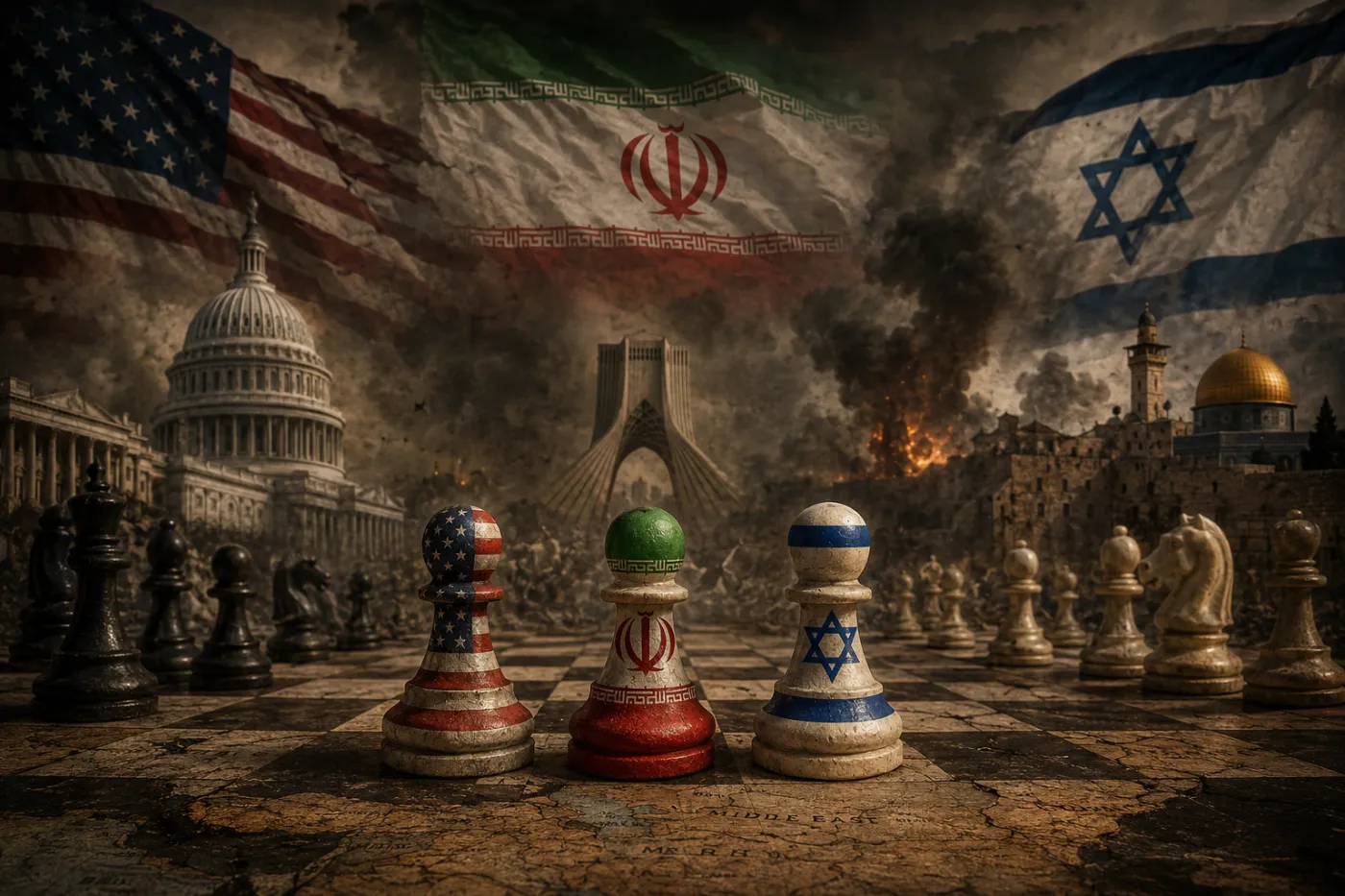

Was the conflict between Iran, Israel and the United States shaped by apocalyptic politics?
Wars are usually explained through the language of strategy: deterrence, security, nuclear thresholds, missile ranges, proxy networks and energy corridors. But some wars are also narrated through another vocabulary entirely, one rooted in prophecy, redemption and the imagined end of history.
The recent confrontation between Iran, Israel and the United States increasingly appeared to inhabit both worlds at once.
This does not mean policymakers in Washington, Jerusalem or Tehran were secretly attempting to engineer a biblical apocalypse. There is no serious evidence for such a claim. Yet it would be equally naive to ignore how deeply apocalyptic and messianic language has entered the political imagination surrounding the conflict. Across all three capitals, religious narratives have helped transform a geopolitical struggle into something larger, older and more emotionally absolute.
That transformation matters. Because once wars are framed not merely as conflicts of interest but as cosmic struggles between good and evil, compromise becomes morally suspect and diplomacy begins to resemble heresy.
The modern American conversation about Iran and Israel cannot be separated from the rise of Christian Zionism, a movement that sees the modern state of Israel not simply as a strategic ally but as the fulfillment of biblical prophecy. Large segments of the American evangelical right interpret the establishment of Israel in 1948 and Israel’s capture of East Jerusalem in 1967 as sacred history unfolding in real time.
Within that worldview, the Middle East is not merely geography. It is eschatology.
This is where Iran enters the story. In the Book of Ezekiel, chapters 38 and 39 describe the apocalyptic battle of Gog and Magog, a climactic confrontation in which a coalition of nations rises against Israel before being destroyed by divine intervention. Among the nations listed is “Persia.”
For many evangelical interpreters, that single word has become politically explosive.
Modern Iran is frequently cast as the contemporary incarnation of biblical Persia and therefore as a predetermined actor in an unfolding prophetic drama. During the recent war, evangelical commentators, pastors and pro-Israel activists repeatedly circulated interpretations linking the conflict to Ezekiel’s prophecy.
Yet this reading is fundamentally interpretive, not historical. Ezekiel was writing about the geopolitical world of the ancient Near East, not the Islamic Revolutionary Guard Corps, uranium enrichment or the Strait of Hormuz. Biblical scholars have repeatedly cautioned against projecting modern nation-states directly onto ancient prophetic texts.
Still, prophetic language has a peculiar power in politics. It simplifies complexity. It transforms contingent events into destiny.
That rhetorical shift became visible in remarks by Senator Lindsey Graham, who suggested that 2026 could become the year of ending a “2,000-year conflict.” The phrase was historically incoherent but symbolically revealing.
The conflict between Iran and the United States is not 2,000 years old. Nor is the modern Arab-Israeli conflict. The number instead appears to invoke a deeper civilizational memory rooted in the destruction of the Second Temple by Rome in 70 CE, the Jewish diaspora and the eventual re-establishment of Jewish sovereignty in modern Israel nearly two millennia later.
Within parts of the American religious right, Israel’s modern history is often understood not simply as politics but as restoration theology: exile, return and eventual redemption.
This is why terms like “Armageddon” increasingly drift into public discourse whenever war erupts around Israel.
Armageddon itself is a Christian term derived from “Har Megiddo,” the Mount of Megiddo referenced in the Book of Revelation as the gathering place for the final battle between the forces of good and evil. Though frequently associated with Judaism in popular culture, the term is primarily rooted in Christian apocalyptic tradition. Jewish eschatology traditionally centers instead on Gog and Magog and the coming of the messianic age.
Yet the boundaries between theology and politics have become increasingly porous.
Recent commentary revealed growing concern over explicitly apocalyptic rhetoric surrounding the Iran conflict. Religious broadcasters and political activists openly described the war as potentially prophetic. Some evangelical figures even framed Iranian retaliation and Israeli military operations as possible foreshadowings of the Gog-Magog war.
At the same time, it would be misleading to reduce American policy toward Iran to theology. The drivers of confrontation remain overwhelmingly strategic: nuclear proliferation fears, regional deterrence, alliance commitments, domestic politics, maritime security and the balance of power in the Gulf.
But apocalyptic narratives do not need to dictate policy in order to shape it. They merely need to influence the emotional atmosphere around it.
And emotional atmospheres matter in democracies.
In Jerusalem, meanwhile, the conflict was framed through a different but related lens. Since October 7, Israeli political rhetoric has increasingly fused national survival with historical trauma and biblical memory. “Never Again” became not simply a slogan but a governing doctrine. Iran was portrayed not merely as a hostile state but as the architect of a transnational anti-Israeli axis stretching from Gaza to Lebanon and beyond.
For sections of Israel’s religious right, this confrontation carries unmistakably messianic undertones. The survival of Israel is often viewed as inseparable from sacred history itself.
Yet Tehran, too, operates within a deeply ideological and quasi-eschatological framework.
The Islamic Republic has long framed its regional strategy through the language of resistance, martyrdom, liberation of Jerusalem and confrontation with global arrogance. Though different in theology from Christian apocalypticism, the structure is strikingly similar: history becomes moralized, enemies become metaphysical, and geopolitical struggles become sacred missions.
Iranian revolutionary ideology has often portrayed conflict with Israel and the United States not as a temporary strategic dispute but as part of a broader civilizational struggle between justice and oppression.
This convergence is one of the most underappreciated dangers in the modern Middle East.
Because when competing powers all begin interpreting conflict through sacred narratives, escalation becomes easier to justify and restraint becomes harder to defend.
If the enemy is Gog and Magog, negotiation appears futile. If war is part of divine providence, compromise can look like betrayal. If Jerusalem is no longer a real city inhabited by real people but instead the symbolic stage for the end of history, then diplomacy itself begins to lose legitimacy.
The tragedy is that wars remain painfully human no matter how sacred their language becomes.
Missiles are launched by governments, not prophecies. Civilians die because of political decisions, not because ancient texts demand their deaths. Children in Tehran, Haifa, Beirut or Bandar Abbas are not victims of biblical destiny. They are victims of leaders who sometimes wrap modern violence in the vocabulary of eternity.
This does not mean religion is irrelevant. On the contrary, religion remains one of the most powerful forces shaping identity and legitimacy across the Middle East and the United States alike. But there is a difference between religion as moral guidance and religion as geopolitical acceleration.
The Iran war may not have been Armageddon. But it revealed how easily modern conflicts can begin to sound like it.
And that may be dangerous enough.