



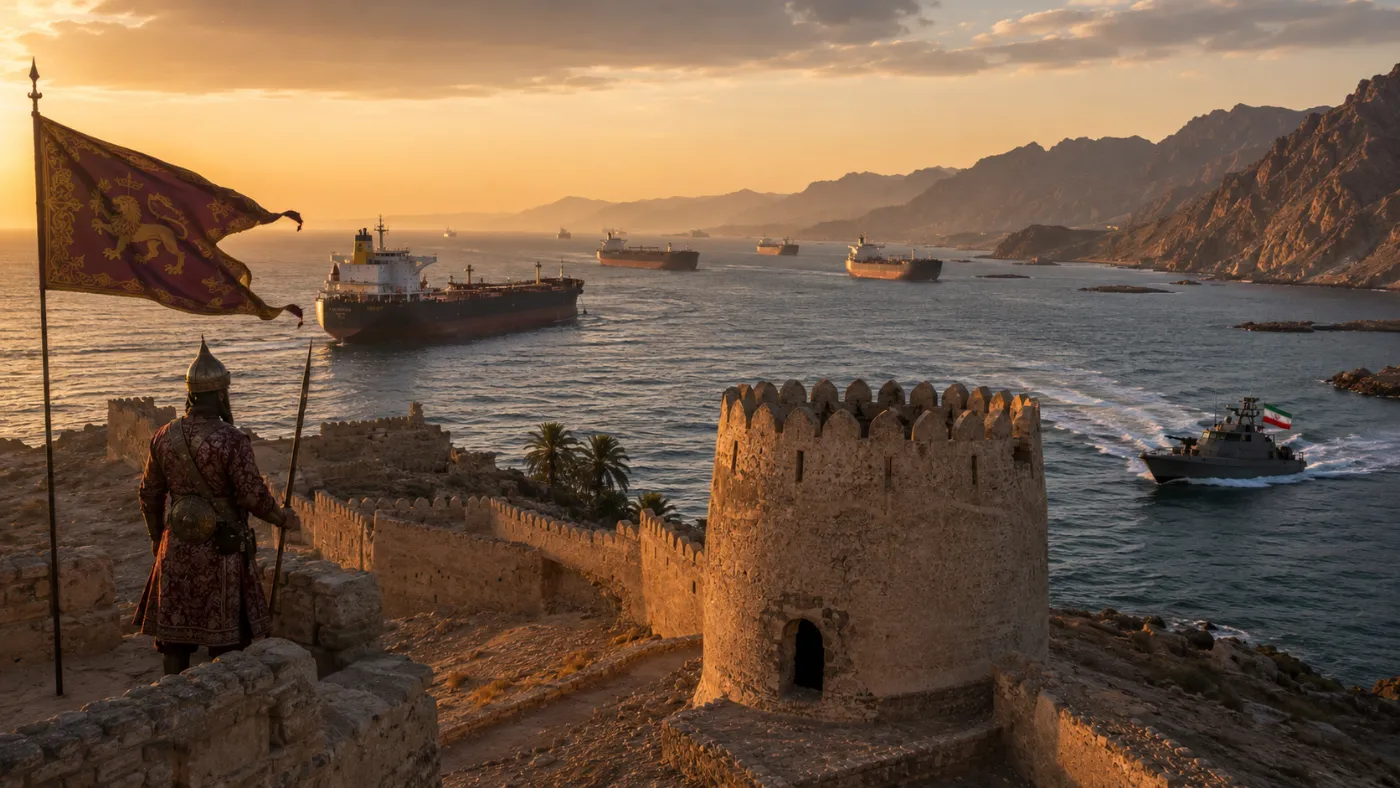

The Strait of Hormuz is not merely a narrow passage of water for Iran. It is one of the most enduring pillars of the country’s geopolitical power. Every state that has ruled Iran has eventually had to confront the same reality: Iran’s security, trade, and regional influence are incomplete without control over the Persian Gulf and the Strait of Hormuz.
From the Safavid era to the Islamic Republic, Hormuz has been the point where geography turns into politics. It is where Iran’s position on the map becomes an instrument of power, pressure, and survival.
In the Safavid period, Iran was still more of a land power than a maritime one. The Safavid state was built around control of the Iranian plateau, war with the Ottomans in the west, and rivalry with the Uzbeks in the east. But the arrival of the Portuguese in the Indian Ocean and the Persian Gulf changed the equation. By taking control of Hormuz in the early sixteenth century, the Portuguese placed one of the most important trade routes between Iran, India, and Europe under their influence.
From that moment, the sea was no longer a marginal question for Iran. It became part of the question of sovereignty.
Shah Abbas I understood this shift better than many rulers before him. He realized that if Iran wanted a meaningful place in regional and global trade, it could not leave the Persian Gulf to foreign powers. Safavid maritime policy was born out of this necessity. It was not the result of a long-standing naval tradition, but of a strategic need to break the Portuguese monopoly and restore Iranian control over southern trade routes.
The recapture of Hormuz in 1622 was one of the defining moments in Iran’s maritime history. With the help of the English East India Company, the Safavids forced the Portuguese out of Hormuz. This victory demonstrated the Safavid state’s determination to assert sovereignty over southern Iran. At the same time, it exposed a structural weakness: Iran could challenge a European maritime power, but only by relying on another one.
In other words, the Safavids understood the importance of the sea, but they did not yet possess the full instruments of maritime power.
After the fall of Portuguese Hormuz, the port of Gombroon gained new importance and was renamed Bandar Abbas in honor of Shah Abbas. This was more than a change of name. It represented an attempt to shift the center of Persian Gulf trade from an island long dominated by Portugal to a port on the Iranian mainland. The Safavids wanted to reconnect trade, taxation, and political authority in the Gulf to Iranian territory.
In this sense, Safavid maritime policy marked the first serious attempt by an early modern Iranian state to turn the southern coast into a component of national power.
Yet this policy had serious limits. Safavid Iran never developed a permanent professional navy comparable to those of Portugal, the Netherlands, or England. Iranian power in the Gulf was exercised largely through ports, local governors, taxation, and temporary alliances, rather than through full naval dominance. As a result, after the decline of central authority following Shah Abbas, Iran’s maritime influence weakened again, and the Persian Gulf increasingly became an arena for foreign competition.
Under the Qajars, this weakness deepened. The Qajar state lacked the financial, military, and administrative capacity to control the southern coasts and islands effectively. At the same time, Britain, which viewed the Gulf through the lens of imperial security and the protection of India, became the dominant external power in the region. From this period onward, Hormuz was no longer simply an Iranian or regional issue. It became part of the wider competition of empires.
The rise of oil transformed the significance of Hormuz once again. Under the Pahlavis, southern Iran was no longer merely a gateway for trade; it became the heart of the country’s oil economy. Oil exports, the security of the Persian Gulf, and the free passage of ships became central pillars of Iran’s foreign and security policy.
Mohammad Reza Shah sought to turn Iran into the principal power of the Persian Gulf. The expansion of the navy, the purchase of advanced military equipment, and the claim that Iran had a special role in maintaining regional security all reflected this vision.
During this period, Hormuz changed from a commercial passage into a global energy artery. Iranian oil, along with much of the oil exported by Arab states of the Gulf, passed through this narrow waterway to reach international markets. Any disruption there could have global consequences. The Strait of Hormuz was no longer only about Iran’s national income. It was tied to Iran’s role in the Western security order and the global economy.
After the 1979 revolution, Iran’s view of Hormuz changed again. The Islamic Republic needed secure maritime routes for its own oil exports, but it also turned Hormuz into an instrument of deterrence against the United States, Israel, and regional rivals. The Iran-Iraq War, especially the Tanker War of the 1980s, showed that the Persian Gulf could quickly turn from a route of commerce into a battlefield.
Since then, the Strait of Hormuz has occupied a special place in the Islamic Republic’s security strategy. Tehran knows that it cannot compete directly with the United States in a conventional naval war. But it can raise the cost of safe passage through Hormuz by using asymmetric tools: fast boats, sea mines, coastal missiles, drones, and the presence of the Revolutionary Guards across the southern coasts and islands.
In the political language of the Islamic Republic, threatening to close the Strait of Hormuz is not merely a military threat. It is a tool of bargaining, deterrence, and psychological pressure on global energy markets.
The power of this threat lies in the importance of the waterway itself. A significant share of the oil and gas exported from the Persian Gulf passes through Hormuz. Any crisis there can push up energy prices, alarm global markets, and force major powers to respond. The Islamic Republic has built its strategy around precisely this vulnerability: turning the world’s dependence on a narrow maritime chokepoint into political leverage.
But Hormuz is both an opportunity and a vulnerability for Iran. Iran can use its geography as a tool of deterrence, but its own economy also depends on the same route. A prolonged crisis in Hormuz could threaten Iran’s oil exports, maritime trade, and economic security. In this sense, Hormuz is a double-edged sword: it is an instrument of power, but excessive use of it can damage Iran itself.
Looking at the history of Hormuz from the Safavids to the Islamic Republic reveals a continuous pattern. Whenever Iranian states have taken the sea seriously, they have strengthened their regional position. Whenever they have neglected maritime power, foreign powers have filled the vacuum.
The Safavids demonstrated, by expelling the Portuguese from Hormuz, that Iranian sovereignty was incomplete without control over the Persian Gulf. The Qajars showed that claims of sovereignty mean little without the capacity to enforce them. The Pahlavis connected Hormuz to oil, naval power, and Iran’s regional role. The Islamic Republic turned it into an instrument of asymmetric deterrence.
The main difference lies in how each state imagined the function of Hormuz. The Safavids saw it as a gateway connecting Iran to global trade. The Islamic Republic sees it both as an economic lifeline and as a pressure point against the global economy. For the Safavids, controlling Hormuz meant restoring Iran’s access to trade and wealth. For the Islamic Republic, controlling Hormuz also means the ability to disrupt the calculations of its adversaries.
The strategic importance of the Strait of Hormuz has changed form over time, but it has never disappeared. In the seventeenth century, the key issue was trade and the removal of Portuguese power. In the twentieth century, it was oil and energy security. In the twenty-first century, Hormuz has become one of the most sensitive points of contact between Iran, the United States, Arab Gulf states, and the global energy market.
For this reason, the Strait of Hormuz should be understood not only as a maritime passage, but as part of Iran’s strategic memory. It reminds Iran that national power is not built only in capitals, mountains, and land borders. It is also built in ports, islands, shipping lanes, and the ability to control the sea.
The Safavids first learned this lesson in their confrontation with Portugal. The Islamic Republic now rereads the same geography through the language of missiles, oil, and deterrence.
In the end, the history of the Strait of Hormuz is the history of Iran’s attempt to turn geography into political power. Every ruler of Iran has had to answer the same question: is Hormuz merely a route for ships, or is it a tool for shaping the country’s destiny?
History’s answer is clear. For Iran, Hormuz has always been more than a strait.