





Saudi Arabia’s long-term trajectory is anchored in a single, defining framework: Vision 2030. Often misunderstood as merely an economic reform plan, Vision 2030 is, in reality, the kingdom’s grand strategy—a comprehensive blueprint to transform Saudi Arabia from an oil-dependent state into a diversified, globally integrated power with geopolitical, technological, and financial influence.
A large-scale confrontation between Iran and the United States—particularly one that spills into direct or proxy attacks on Saudi territory—would not erase this strategy. But it would fundamentally reshape how it is implemented. War would force Riyadh to adapt its grand strategy from one centred on rapid transformation to one grounded in strategic resilience.
Vision 2030: Saudi Arabia’s Grand Strategy
At its core, Vision 2030 is not just about economic diversification—it is about repositioning Saudi Arabia in the global order. The strategy rests on three interconnected pillars:
- Economic transformation: Reducing reliance on oil by developing sectors such as tourism, finance, logistics, mining, and technology
- State-led investment power: Using sovereign wealth—primarily through the Public Investment Fund (PIF)—to drive domestic growth and global influence
- Geopolitical repositioning: Turning Saudi Arabia into a central hub connecting Asia, Europe, and Africa, while maintaining strategic autonomy in foreign policy
In this sense, Vision 2030 functions as a grand strategy in the classical sense: it integrates economic policy, foreign policy, and national security into a single long-term vision of power.
Crucially, the success of this strategy depends on stability. Investor confidence, infrastructure development, and global partnerships all require a predictable environment. A regional war directly challenges that foundation.
War would force Riyadh to adapt its grand strategy from one centred on rapid transformation to one grounded in strategic resilience.
Repricing Risk: The New Reality for Global Capital
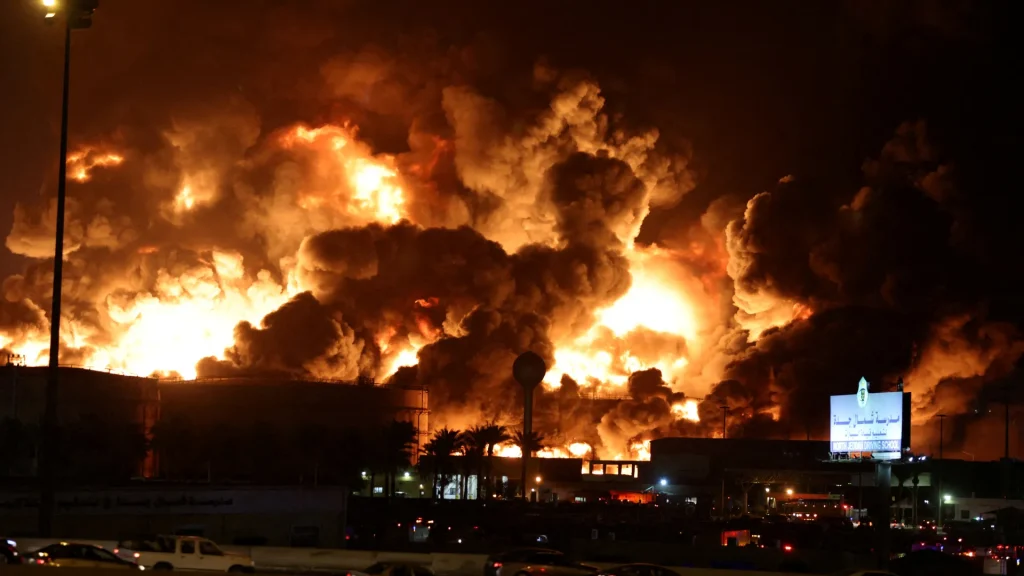
In the aftermath of a conflict involving Iran, Saudi Arabia would face a sharp reassessment by global markets. Even limited attacks on infrastructure—energy facilities, ports, or urban centres—would alter investor perception.
The kingdom’s narrative as a stable transformation hub would be tested. Insurance costs would rise. Supply chains would become less reliable. Talent attraction would slow down. Capital would not disappear—but it would become more selective.
The nature of foreign investment would shift. Sectors tied to long-term national priorities—energy, logistics, defence, cybersecurity, and industrial infrastructure—would remain attractive. By contrast, sectors dependent on perception—tourism, entertainment, and luxury real estate—would face increased scrutiny.
The result is not disengagement, but recomposition: from opportunity-driven capital to security-aligned capital.
From Transformation to Resilience
War would not end Vision 2030—it would harden it.
Saudi Arabia’s grand strategy would undergo a reordering of priorities. Before conflict, Riyadh could pursue expansive ambitions: megacities, global events, and rapid urban transformation. After conflict, resilience would take precedence.
Infrastructure protection, missile defence, cyber capabilities, and supply chain security would move to the centre of national planning. Strategic assets would be dispersed. Critical industries would be insulated. Projects would be evaluated not only on economic return but also on their ability to withstand disruption.
This shift marks the emergence of a fortified development model—a hybrid system where openness to global capital coexists with deep structural safeguards.
Diplomacy Recalibrated: Deterrence and Balance
Saudi Arabia’s foreign policy has already evolved toward pragmatism—balancing relations with major powers while reducing regional tensions. A war involving Iran would not reverse this trend, but it would intensify it.
Riyadh would likely pursue a dual-track approach:
- Enhanced deterrence: Deepening security cooperation with allies, strengthening defence systems, and increasing military readiness
- Strategic flexibility: Maintaining diplomatic channels to manage escalation and avoid prolonged confrontation
This approach reflects a broader reality: Saudi Arabia’s grand strategy is not built on ideological alignment but on strategic autonomy. In a more volatile region, that autonomy becomes even more critical.
Geography and the Return of Strategic Constraints
One of the most immediate lessons of war would be the renewed importance of geography. Despite diversification efforts, Saudi Arabia remains deeply tied to regional energy routes and trade corridors.
Disruptions to maritime chokepoints would accelerate efforts to develop alternative export routes, particularly through the Red Sea. Logistics infrastructure would be redesigned with redundancy in mind. Energy security would become inseparable from route diversification.
In this context, diversification itself takes on a new meaning. It is no longer just about economic growth—it is about reducing vulnerability to geopolitical shocks.
Western Companies and the New Investment Logic
For Western firms, Saudi Arabia would remain indispensable—but different.
The investment environment would shift from one defined by rapid expansion to one shaped by risk management. Companies would prioritise sectors aligned with state priorities and backed by sovereign guarantees. Partnerships would become more structured, with greater emphasis on resilience and long-term alignment.
The threshold for investment would rise. Firms willing to operate in complex environments would find opportunities. Those seeking low-risk, high-predictability markets may hesitate.
Saudi Arabia, in turn, would become more selective—favouring investors who align with its strategic goals rather than those driven solely by short-term returns.
Vision 2030, Rewritten by Conflict
Saudi Arabia’s grand strategy—Vision 2030—would not be abandoned in the face of war. But it would be transformed.
The kingdom would continue to pursue diversification, global integration, and economic modernisation. Yet these goals would be embedded within a new strategic logic: resilience over speed, security over spectacle, endurance over optimism.
In a more dangerous Middle East, Saudi Arabia would not retreat from its ambitions. It would adapt them—redefining what it means to modernise in an era where stability is no longer guaranteed but must be actively secured.